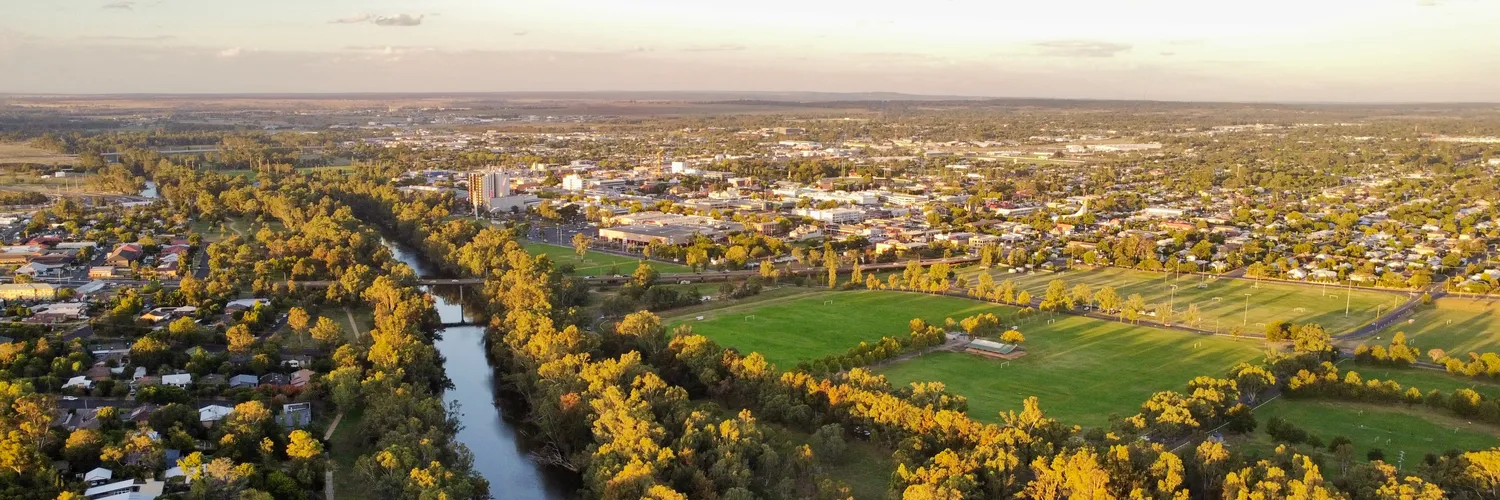
The Central West gets sold to investors as one region. It isn’t. Bathurst’s median house price is $665,000 and Dubbo’s is $670,000. Over the year to June 2026, Bathurst houses grew 1.53% while Dubbo houses grew 13.56%.
Almost the same money in, nearly nine times the growth rate out. That’s before you get to what happens inside each town, where the spread gets wider again.
Why the Central West isn’t one market
On a map these four towns look like one decision. Orange, Bathurst, Dubbo and Mudgee all sit west of the Blue Mountains and run on health, education and agriculture. All four price between $665,000 and $749,995 for a median house.
They run on different engines. Orange has a wine and mining district. Bathurst is a government and university town. Dubbo is the services hub for its region. Mudgee is a smaller wine and mining town with a fraction of the turnover.
Those engines fire at different times, which is why four medians sitting within $85,000 of each other produced growth rates between 1.53% and 13.56%.
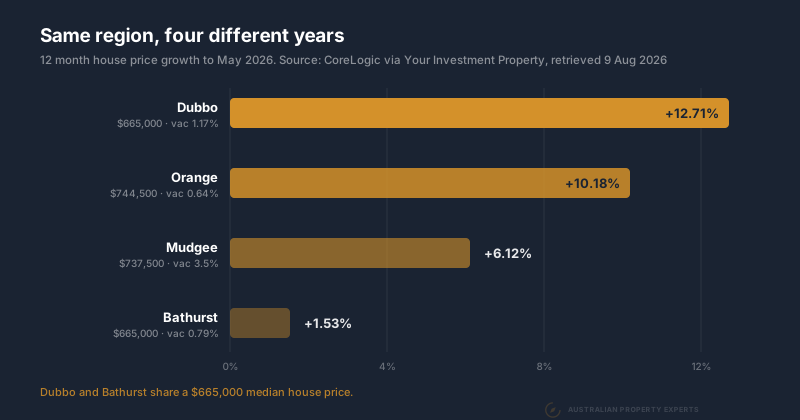
One caveat before you read too much into a single year. Regional medians move on what sold as well as what things are worth. A quiet twelve months in a small market isn’t the same as a market going nowhere. Bathurst is the clearest example of that, which is why it gets a section rather than a dismissal.
Dubbo: the strongest year of the four
Dubbo had the best twelve months, on a median only $5,000 above the lowest-priced town here. Houses grew 13.56% to $670,000 on a 4.50% gross yield. With 1,080 houses changing hands in the year, it’s the deepest market of the four. Homes averaged 28 days on market.
Units look spectacular and we’d treat them carefully. A $416,500 median, a 5.06% gross yield, and 29.75% growth reads like the find of the year. Then you see that only 45 units sold in twelve months. A market that thin can move 20% on a handful of transactions, so it’s a signal worth checking, not a number to buy on.
The structural story is the Central-West Orana Renewable Energy Zone, which is expected to draw up to $25 billion of private investment into the region. Vacancy sat at 1.24% in August 2026. The Dubbo buyers agent page has the suburb-level breakdown.
Bathurst: why the town median misleads
Bathurst’s headline is the weakest of the four and the most misleading. The town median grew 1.53% to $665,000 on a 4.30% yield. Underneath it, the suburbs investors actually buy in moved. West Bathurst grew 8.85%, Kelso 8.11% and Windradyne 7.61% over the same twelve months.
There’s a second reason to discount that 1.53%. The figure covers only the central Bathurst locality, which traded 160 houses in the year, against 1,080 in Dubbo and 971 in Orange. Kelso alone sold 233. A median built on 160 sales moves on what happened to sell, so one quiet year is weak evidence either way.
That’s the same lesson as the regional one, a level down. A town median blends the family suburb belt with everything else. If you buy the average, you get the average.
Bathurst is a government and university town with a $200 million hospital redevelopment under construction and due in 2028. Vacancy was 0.65% in August 2026, the tightest of the four. Entry runs from about $615,000 in West Bathurst to $721,000 in Windradyne. Units did better than houses on the headline, up 4.17% to a $487,000 median at a 4.70% yield. The Bathurst buyers agent page carries the suburb detail.
Orange: the premium address
Orange is the most expensive of the four and had the second-strongest year. The median house sits at $749,995 on a 4.16% yield, with 10.29% growth. Units run $495,000 at 4.94%.
It’s also liquid, with 971 houses sold in twelve months at an average 35 days on market. That matters more than investors give it credit for. Depth means you’re not overpaying for scarcity going in, and you’re not waiting for the one buyer who wants your street going out.
Vacancy sat at 0.71% in August 2026, second only to Bathurst. The employment base spreads across health, education, the wine district and mining. That mining exposure is worth checking rather than fearing. We map the tenant pool before we buy, and pass on anything leaning on a single mine. That detail sits on the Orange buyers agent page.
Mudgee: strong prices, loose rentals
Mudgee is where the pattern breaks. Houses grew 5.57% to a $739,000 median at a 4.43% yield, which reads fine. Units went backwards, down 2.72% to $500,000, though they still carry a 5.15% yield.
The rental market is the part to weigh. Vacancy sat at 3.64% in August 2026. Our suburb scorecard calls anything under 2% strong and treats 4% as the walk-away line, so 3.64% sits in caution territory. Mudgee costs within $11,000 of Orange and carries more than five times the vacancy. Loose vacancy is what turns a good yield on paper into eight weeks of empty rent.
The town has a case. The $70.7 million hospital redevelopment is complete. The 400MW Stubbo Solar plant near Gulgong began operating in late 2025, with its battery still being delivered. But we’d want that rental market tighter before buying here for a client, and the Mudgee buyers agent page carries the same caveat.
Central West medians and yields
| Town | House median | Yield | 12m growth | Sales | Days | Vacancy |
|---|---|---|---|---|---|---|
| Orange | $749,995 | 4.16% | +10.29% | 971 | 35 | 0.71% |
| Bathurst | $665,000 | 4.30% | +1.53% | 160 | 57 | 0.65% |
| Dubbo | $670,000 | 4.50% | +13.56% | 1,080 | 28 | 1.24% |
| Mudgee | $739,000 | 4.43% | +5.57% | 348 | 65 | 3.64% |
House medians, growth, sales counts and average days on market are CoreLogic for the twelve months to 30 June 2026, retrieved 26 September 2026. Yields are median rent to 31 August 2026 times 52, divided by the median. Vacancy is SQM Research, August 2026. Bathurst is the central Bathurst locality.
Four answers, not a ranking. Dubbo has the growth, the yield and the fastest turnover at 28 days. Orange has tight rentals and almost as much depth. Bathurst has the tightest rentals and a suburb story its thin median hides. Mudgee takes 65 days to sell and carries the loosest rentals of the four.
What to check in regional NSW
Check the tenant pool before the yield. A 5% gross yield in a town where one employer dominates is a different asset to the same yield spread across health, education and agriculture. Ask who rents this specific house.
Check sales volume, because it decides both your exit and how much a median is worth trusting. Dubbo sold 45 units in a year and its unit median moved 29.75%. Those two numbers belong together.
Check the suburb, not the town. Bathurst’s median said 1.53% and West Bathurst said 8.85%. Both are true and only one of them is the property you’d buy.
Treat construction pipelines as temporary tenants. A hospital build employs people for a defined window, which supports rents while it runs and stops when it stops. The question is what holds the tenant up afterwards.
Who the Central West suits
This region works for investors who want growth and yield in the same purchase at a price that still leaves room to buy again. House yields of 4.16% to 4.50%, and unit yields above 5% in Dubbo and Mudgee, do that job.
What it won’t do is let you buy a region and call it a strategy. Two towns here sit $5,000 apart on median and finished the year almost nine times apart. Inside the slower one, a suburb ran more than five times faster than its own town average. You pick the town, then you pick the street. The same pattern holds further north, where Armidale and Inverell share a region and little else, in our New England market breakdown.
This is general information only and not financial advice. Speak to a qualified professional before making investment decisions.
If you want the Central West assessed against your budget and strategy rather than a hotspot list, book a free discovery call.
Sources
- Medians, rents, 12 month growth, sales volumes and days on market: Your Investment Property, CoreLogic data for the twelve months to 30 June 2026 (rents to 31 August 2026), retrieved 26 September 2026 (Orange, Bathurst, Dubbo, Mudgee)
- Bathurst suburb-level growth and entry prices: CoreLogic suburb data to 30 June 2026, as set out on our Bathurst buyers agent page
- Vacancy rates: SQM Research, August 2026 (postcodes 2800, 2795, 2830, 2850)
- Infrastructure: NSW Health redevelopment programs (Bathurst, Mudgee), EnergyCo Central-West Orana Renewable Energy Zone, Stubbo Solar Farm


_in_Dubbo,_NSW_2026_2.jpg)