Plenty of investors buy one property and stop. Equity recycling is how others keep going. You buy, the property grows, you refinance, and the released equity funds the next purchase without saving a second cash deposit.
What Is Equity Recycling?
Equity recycling is the buy-hold-refinance-repeat loop. Instead of saving a second deposit from scratch, you let your first investment property’s growth create one.
The sequence:
- Buy property one using home equity as the deposit.
- Do a cosmetic reno to force equity above organic growth.
- Hold for 18 to 24 months while the market and the reno lift the value.
- Get the property revalued by the bank.
- Refinance at 80% LVR and release the equity above your loan balance.
- Use that release as the deposit and costs on property two.
Then run the loop again. Property two grows, generates equity, funds property three. Each cycle compounds because more assets are growing at the same time. Our equity recycling calculator models the timing of each purchase based on your numbers.
Refinancing is not a sale, so releasing equity does not trigger capital gains tax. Selling a property to recycle the cash is different. From 1 July 2027, the 50% CGT discount on established property is replaced by indexation of the cost base, plus a 30% minimum tax on the gain (Act No. 49 of 2026). Growth earned up to 30 June 2027 keeps the 50% discount. Our 2027 changes playbook covers the detail.
The Numbers on a $460,000 Buy
An established three-bedroom house in a lower-priced regional Queensland market. $460,000 purchase price. That is well under the regional Queensland house median of $851,499 at August 2026 (Cotality). Here is what it takes to get in:
- 80% loan (interest-only): $368,000 ($460,000 x 80%)
- Deposit: $92,000 ($460,000 x 20%)
- QLD transfer duty: $14,525 ($1,050 + 3.5% of the $385,000 above $75,000)
- Conveyancing, inspections, loan fees: $3,500
- Total equity needed: $110,025
That $110,025 comes from releasing equity against your home. If you plan to renovate, release another $30,000 for the cosmetic budget, making the total draw about $140,000.
Holding cost at current rates. The average variable rate on new investment loans was 6.4% in July 2026 (RBA table F6). Interest-only repayments at that rate come to $1,963 per month ($368,000 x 6.4% / 12). This example assumes rent of $420 per week, a 4.7% gross yield ($420 x 52 / $460,000). That is $1,820 per month ($420 x 52 / 12). Pre-tax shortfall on interest alone: $143 per month.
After a $30,000 cosmetic reno (paint, flooring, kitchen refresh), the assumed rent rises to $460 per week, or $1,993 per month. Rent then covers the interest with about $30 a month to spare. Rates, insurance and management fees still sit on top. For an established home bought after 7.30pm on 12 May 2026, a rental loss from 1 July 2027 can no longer be claimed against salary. It carries forward against future rental income or a capital gain. For the full breakdown of what cosmetic work moves the valuation, see our guide to cosmetic renovations that force equity.
The reno runs three to five months after settlement. That gives you time to get trades quoted, coordinate with your property manager on tenant notice, and line up the work. Once it finishes, you relist at the higher rent. Ask your broker how long your lender wants you to own the property before it will revalue above the purchase price.
The Refinance at Month 24
Two things have happened over the first two years.
Organic growth. Australian dwelling values rose 66.5% over the ten years to August 2026, about 5.2% a year compounded (Cotality Home Value Index). This example assumes that 5.2% a year. It lifts a $460,000 property to about $509,000 over two years ($460,000 x 1.052 x 1.052). The market is falling right now. National values rose 2.7% over the year to August but were 3.6% below their March 2026 peak. Regional Queensland rose 9.1% over the year, yet sat 1.3% below its May peak. The first two years could easily run below the decade average.
Reno uplift. This example assumes the $30,000 of paint, flooring and kitchen work adds $40,000 to the value. That is an assumption, not a rule. Ask a local valuer or agent what comparable renovated homes sell for before you spend.
Combined, the property sits around $549,000 ($509,000 + $40,000). The bank values it conservatively at $545,000.
The equity release:
- 80% of $545,000 = $436,000
- Minus existing loan: $368,000
- Usable equity: $68,000
That $68,000 goes toward the deposit and costs on property two. Say property two costs $470,000. It needs $112,375 for the deposit, duty and costs ($94,000 + $14,875 duty + $3,500). The $44,375 gap comes from your home equity, which has also been growing. An $850,000 home growing at the same assumed 5.2% a year gains about $90,700 over two years. That adds roughly $72,600 of new usable equity ($90,700 x 80%).
Our home equity calculator works out the usable equity in your own property.
Why Property Three Comes Faster
At month 24 you had one investment property generating equity. Now you have two.
Property two. Same playbook at $470,000. Same loan structure, same cosmetic reno. After another 24 months at 5.2% growth plus the $40,000 reno uplift, property two is worth about $560,000 ($470,000 x 1.052 x 1.052 + $40,000). Valued conservatively at $555,000, it releases $68,000 ($555,000 x 80% less the $376,000 loan).
At the same time, property one kept compounding. Its value climbed from $545,000 to roughly $603,000 over those two years ($545,000 x 1.052 x 1.052). The new 80% line is about $482,500. The loan balance is now $436,000, because it rose when the $68,000 was released. That leaves another $46,500 available.
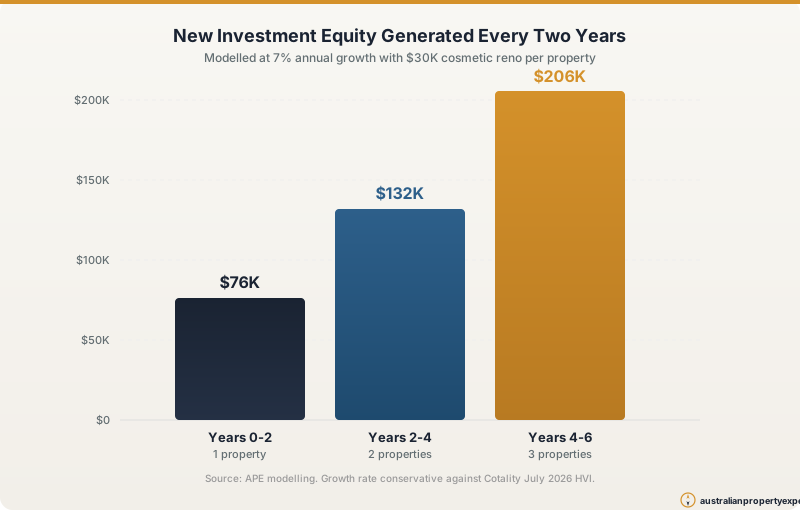
New equity generated every two years, from the investment properties alone:
- Years 0 to 2, one property working: $68,000
- Years 2 to 4, two properties working: $114,500 ($68,000 + $46,500)
- Years 4 to 6, three properties working: about $167,000 (property one $51,500, property two $47,400, property three $68,000)
The years 4 to 6 line assumes property three is also bought at $470,000 on the same playbook. Each property added to the loop makes the next deposit arrive faster. In years 2 to 4, the investment properties alone release about $114,500. That covers property three’s $112,375 deposit and costs without drawing on the home. By property four, the bank’s serviceability test usually becomes the main limit on buying again.
And these figures only count equity from the investment properties. Your home is growing alongside them. At the assumed 5.2% a year, it adds its own equity on top of everything above. By year four, the combined equity across home and two investment properties makes property three’s deposit and costs straightforward.
What Can Stall the Cycle
Equity recycling works when several conditions hold. Four things slow it down or stop it.
The serviceability wall. Every new loan is assessed at the actual rate plus APRA’s 3 percentage point buffer. With new variable investment loans averaging 6.4%, the bank tests you at about 9.4%. A growing portfolio pushes total debt higher. Since 1 February 2026, APRA has limited each bank’s new investor lending at a debt of six times gross income or more to 20% of new loans (APRA). You need both capital growth and rental yield to keep the portfolio serviceable. Growth builds the equity, and rental income helps you pass the bank’s serviceability test so you can use it.
A low bank valuation. The revaluation is the trigger for the whole cycle. If the bank values your property below comparable sales, the usable equity shrinks or disappears. A desktop valuation relies on sales data and cannot see renovation work. Your broker should push for a panel valuer walkthrough, especially if you have done work that a desktop model will not capture.
Flat or falling markets. The worked example assumes 5.2% a year, the national ten-year average. At 3% a year, the same $68,000 release from property one takes about 41 months instead of 24. In a flat market, the reno uplift does all the lifting on its own. On these numbers that releases only $32,000 ($500,000 x 80% less the $368,000 loan). That may not fund the next purchase in a reasonable timeframe. With national values falling for five straight months to August 2026, plan for the slower case. Buying in markets with strong fundamentals, tight vacancy, and supply constraints helps keep the cycle on schedule.
Cross-collateralisation. If your loans are tied together across properties, the bank can refuse to release equity from one property because another has softened. Keep each loan standalone with a separate lender where possible. The cross-collateralisation trap is a structural error that can stop this cycle cold.
Five Rules That Keep It Moving
-
Buy in affordable markets. A $460,000 property growing at 5.2% adds $23,920 in a year. A $900,000 property would need to grow 2.66% to add the same dollars. But you can fund two of the former for the equity cost of one of the latter.
-
Use interest-only loans. IO keeps your cash flow intact and leaves every dollar of principal available to cover holding costs or fund the next reno. The IO premium on investment loans is narrow. New interest-only investor loans averaged 6.5% in July 2026, against 6.3% for principal and interest (RBA table F6).
-
Cosmetic reno only. Paint, flooring, kitchen refresh, bathroom refresh, landscaping. Avoid structural work, extensions and anything that needs council approval or a building contract over $50,000. The goal is to compress two years of organic growth into a few months of targeted work.
-
Separate loans, different lenders. Each property on its own standalone loan. No cross-collateralisation. This lets you refinance one property without the bank revaluing everything else in your portfolio.
-
Get the broker right. An investment-savvy mortgage broker structures each loan so the next refinance can fund the next purchase. They spread your lending across multiple institutions to preserve borrowing capacity. A bank’s own lending manager can’t do this, because they only offer that bank’s loans.
How Three Properties Compound
The worked example above shows a three-property portfolio built over four years at an assumed 5.2% a year. The investor started with home equity and did not save a single additional deposit from income. Every purchase was funded by growth in what they already owned. Growth at that pace is only an assumption, and values were falling at August 2026.
Equity recycling works because the cycle speeds up each time you add another property. For the full strategy, including team structure, trust conversations, and the path beyond property three, read our guide to building a property portfolio.
This is general information only and not financial, tax, or credit advice. Speak to a licensed mortgage broker and a qualified professional before making investment decisions.
If you have equity in your home and want to see how many properties it could fund, book a free discovery call.
Sources
- Cotality Home Value Index, August 2026: ten-year and annual change, peak-to-date change, regional Queensland house median
- Housing lending rates, RBA statistical table F6: new investment loan rates, July 2026
- APRA debt-to-income limits
- Treasury Laws Amendment (Tax Reform No. 1) Act 2026, No. 49 of 2026
- QLD transfer duty rates, Queensland Revenue Office