How much equity do you need to buy an investment property? Most people get the number wrong. They either forget about stamp duty and come up short at settlement, or they wait years longer than necessary because they assumed they needed more.
The answer depends on what you buy and where you buy it. Here are three worked examples at real 2026 price points, with every cost line-itemed.
The Formula: Deposit Plus Costs
Your equity needs to cover two things: the deposit and the purchase costs.
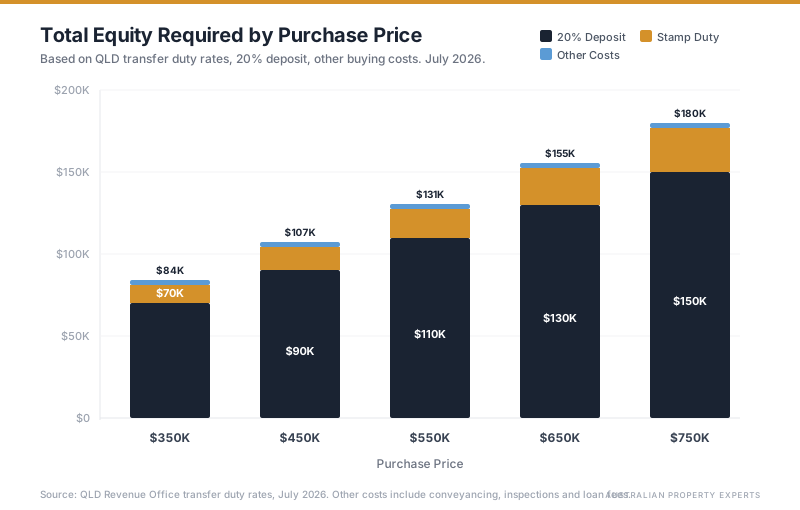
Most investors target a 20% deposit to stay under the 80% loan-to-value ratio and avoid Lenders Mortgage Insurance. On a $500,000 investment property, that is $100,000.
But the deposit is not the full picture. Stamp duty alone adds $12,000 to $27,000 depending on the state and purchase price. On top of that sit conveyancing fees, title searches, building and pest inspections, and loan setup costs. Together, those add another $2,500 to $5,000.
The formula:
Equity needed = 20% deposit + stamp duty + buying costs
That typically works out to 23% to 25% of the purchase price rather than 20%. The gap between what people budget for an investment property and what settlement day actually requires is where problems start.
$400,000 Property: The Numbers
A $400,000 established house is still achievable in parts of regional Queensland, South Australia’s northern corridors, and pockets of Western Australia and Tasmania. At that price point in Queensland, here is the full cost breakdown:
- 20% deposit: $80,000
- Transfer duty (QLD): $12,425
- Conveyancing and legal fees: $1,500 to $2,500
- Building and pest inspection: $500 to $800
- Loan application and registration fees: $500 to $1,000
Total equity needed: approximately $95,000 to $97,000
To release that amount from your home, the bank will lend up to 80% of its current value. So the question becomes: is 80% of your home’s value minus your mortgage balance at least $97,000? Our usable equity calculator gives you the number in ten seconds.
- Home worth $700,000 with $300,000 owing: usable equity of $260,000. Plenty.
- Home worth $600,000 with $350,000 owing: usable equity of $130,000. Enough, with a comfortable buffer.
- Home worth $500,000 with $350,000 owing: usable equity of $50,000. Short by almost half.
If usable equity is a new concept, our guide to using home equity for an investment property walks through the 80% calculation and how the release actually works. And make sure the equity release is set up as a separate loan split, not cross-collateralised with the investment loan.
$550,000 Property: The Numbers
At $550,000 you open up established houses in Adelaide’s middle-ring suburbs, Brisbane’s outer corridors, and parts of Perth where growth has been strongest. Adelaide’s median dwelling value sat at $942,000 in June 2026 (PropTrack), but plenty of investor-grade suburbs sit well below that headline figure.
The Queensland breakdown at $550,000:
- 20% deposit: $110,000
- Transfer duty (QLD): $17,775
- Conveyancing and legal fees: $1,500 to $2,500
- Building and pest inspection: $500 to $800
- Loan application and registration fees: $500 to $1,000
Total equity needed: approximately $130,000 to $132,000
In NSW the stamp duty on a $550,000 investment property runs to $19,162, pushing total equity needed toward $132,000 to $133,500. SA charges more again. The gap between the cheapest and most expensive states at any given purchase price can be $5,000 to $10,000. Our stamp duty calculator gives you the exact figure for your state and price.
These middle-price-point markets are often where the growth and yield numbers work hardest together. The entry cost is higher than a $400,000 property but the locations tend to be closer to employment centres and transport, which supports both rent and long-term capital growth.
$750,000 Property: The Numbers
At $750,000 you are in capital city territory. The Queensland breakdown:
- 20% deposit: $150,000
- Transfer duty (QLD): $26,775
- Conveyancing and legal fees: $2,000 to $3,000
- Building and pest inspection: $500 to $800
- Loan application and registration fees: $500 to $1,000
Total equity needed: approximately $180,000 to $182,000
The home backing this release needs serious headroom. A property worth $1,000,000 with $400,000 owing gives $400,000 of usable equity, more than enough. A property worth $800,000 with $500,000 owing gives just $140,000 of usable equity, which is $40,000 short.
This is one reason we steer investors toward affordable markets rather than stretching into higher price brackets. A $450,000 investment property growing at 8% per year delivers $36,000 of growth. A $750,000 property needs to grow 4.8% just to match that in dollar terms, while requiring almost twice the equity to enter. The data shows affordable markets have outperformed blue chip on both growth and yield.
The Costs People Forget
Deposit and stamp duty make up around 95% of the total. But a few smaller items catch people off guard.
Bank valuation shortfall. The lender values your home, not you. If the bank values your home at $680,000 when you expected $720,000, your usable equity drops by $32,000. A $40,000 valuation gap costs you $32,000 of borrowing capacity because the 80% LVR line moves with the valuation. Order an upfront valuation through your broker before you build a purchase budget around a guess.
LMI if you go above 80%. Some investors accept LMI to enter the market sooner. On a $750,000 investment property at 90% LVR, LMI lands somewhere between about $16,000 and $29,000 depending on the lender, because insurers and lenders price the same LVR very differently (money.com.au, updated August 2026). Our LMI calculator prices the range at your deposit size. It scales down at lower purchase prices, but it is always an extra cost that comes straight off your position.
Cash buffer. Having zero dollars left after settlement is a bad position. With variable investor rates averaging 7.20% in July 2026 (Finder), interest-only repayments on a $320,000 loan run roughly $1,920 per month. Most brokers and lenders want to see at least two to three months of repayments sitting in reserve beyond the purchase costs. That adds $4,000 to $6,000 to the real number you should have available.
Serviceability Cuts It Further
Having the equity is the first test. The second is income.
Lenders assess your ability to repay at the actual interest rate plus APRA’s 3% serviceability buffer. With variable investor rates around 7.20%, you are being tested at roughly 10.20%. That assessment rate shrinks your borrowing power well below what today’s actual repayments suggest you could handle.
Since February 2026, APRA also caps high-DTI lending. Banks can write only 20% of new loans to borrowers whose total debt is six times their gross income or more. Releasing equity from your home pushes your total debt up, so this constraint hits equity-release investors directly. Loans for new dwellings are exempt, but most investors buying established houses are not.
The practical effect: some homeowners have $200,000 in usable equity but can only service enough new debt to fund a $450,000 investment property, not a $650,000 one. Run the serviceability check with a good mortgage broker before you lock in a purchase price. It is faster than the equity check and it sets the real ceiling.
What If You’re $20,000 Short?
Three paths, roughly in order of preference.
Wait for growth. If you are close, six to twelve months of organic growth may close the gap. Australian dwelling values have averaged around 5% to 6% annual growth over the last 30 years (Cotality). On a $700,000 home, that is $28,000 to $34,000 of new usable equity per year before you have done anything. One good year can turn “not quite enough” into “comfortable buffer.”
Pay down faster. Every dollar off your home loan is a dollar of new usable equity. Directing a bonus, tax refund, or salary increase toward the mortgage accelerates the timeline without waiting for the market. The maths is one-for-one: reducing your loan by $20,000 adds exactly $20,000 of usable equity. To see how released equity compounds into the next purchase and the one after, run the sequence through our equity recycling modeller.
Buy cheaper. The difference in total equity needed between a $450,000 investment property and a $550,000 one is roughly $24,000. Dropping one price bracket does not mean dropping quality. Some of the best-performing investor markets in the country sit below $500,000, and the entry barrier at that level is far more manageable.
Accepting LMI is a fourth option. It suits investors who can service the loan but do not quite have 20% equity for a deposit. The earlier entry may offset the extra upfront cost if the market is moving. Talk to your broker about whether the timing makes that trade worthwhile.
The Number That Matters
For most investors buying in affordable markets, the answer is roughly $95,000 to $135,000 in usable equity. That covers a 20% deposit plus stamp duty and buying costs on a $400,000 to $550,000 investment property, which is where the growth-plus-yield maths works best and holding costs stay manageable.
If you are buying interstate - and most data-led investors should be - the purchase costs shift by state but the formula stays the same. Deposit, stamp duty, legals, buffer.
We run this calculation for every client before sourcing begins. The equity number, the serviceability check, and the target market that fits both.
This is general information only and not financial, tax, or credit advice. Speak to a licensed mortgage broker and a qualified professional before making investment decisions.
See how we find the properties that equity buys.
If you have equity in your home and want to know what it could fund across Australia’s best investor markets, book a free discovery call.
Sources
- Queensland transfer duty rates - Queensland Revenue Office
- Transfer duty - Revenue NSW
- Long-term dwelling value growth - Cotality
- Average variable investment loan rates July 2026 - Finder
- APRA macroprudential settings (serviceability buffer) - APRA
- APRA debt-to-income limit - APRA
- Lenders mortgage insurance guide - money.com.au
- PropTrack median dwelling values June 2026