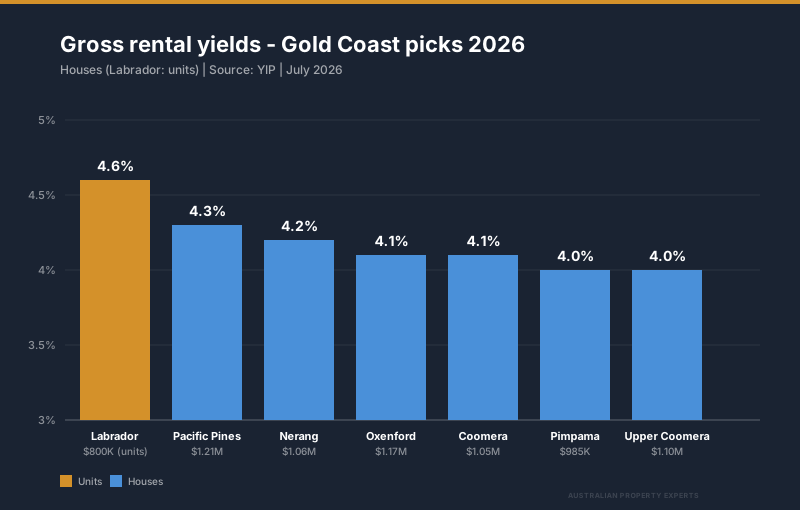
The best suburbs to invest in on the Gold Coast in 2026 aren’t on the beach. Beachfront prices skew any Gold Coast average. A Burleigh Heads house now has a $1.9 million median. Across the northern corridor and hinterland, established houses trade between $995,000 and $1.21 million. Their gross yields run from 3.78% to 4.11%. Every unit market on this list out-yields all six house picks, and that gap is the most useful thing in the data. For current medians, vacancy and supply data, see our Gold Coast property market overview.
Seven suburbs below, selected on median price, gross rental yield, infrastructure pipeline and employment diversity. Each one sits away from the coastal premium. That is where the investor maths actually works.
Every yield here is worked out as weekly rent times 52 divided by the median, so the three numbers in each block reconcile with each other. Published yield figures for these suburbs draw the rent from a later date than the median. That mostly makes the return read higher than the property pays.
Pimpama
Median house price: $995,000 Gross rental yield (houses): 4.02% computed Median weekly rent: $770 12-month growth: +17.06%
Pimpama sits at the northern edge of the Gold Coast, roughly 30km from Surfers Paradise and 45km from the Brisbane CBD. It’s closer to Logan than to Burleigh Heads. That’s exactly why it still works for investors.
The catalyst here is rail. Pimpama station opened on 20 October 2025, the first new station on the South East Queensland network in nearly a decade. It has 380 car parks and direct connectivity to Brisbane. That rail connection has permanently changed the suburb’s commuter profile.
At a median of $995,000 with rents of $770 per week, the yield works out at 4.02%. It’s tighter than 12 months ago. The fundamentals still hold up, though. Over the year, 424 houses sold at an average of 15 days on market. Demand is real, not speculative.
Housing stock is predominantly 2010s-era builds on smaller blocks. Granny flat potential is limited. The play here is rail-driven growth plus sustained rental demand from the northern corridor’s population growth.
Coomera
Median house price: $1,050,000 Gross rental yield (houses): 3.96% computed Median weekly rent: $800 12-month growth: +17.19%
Coomera house prices rose 17.19% over the year to June 2026. The median now sits at $1.05 million.
What’s driving it isn’t hype. The 600-bed Coomera Hospital is being built in the suburb, with Multiplex appointed to deliver it in September 2026. It opens in stages from 2028, and all 600 beds are due by 2032. That’s a large health employer landing in the northern corridor over the next decade.
Coomera already has heavy rail (Coomera station on the Gold Coast line), Westfield Coomera for retail employment, and the Coomera Town Centre precinct growing around it. At $1,050,000 with a 3.96% yield and $800 per week in rent, the cash flow is tight on an interest-only loan. Growth is doing the heavy lifting here.
For investors targeting both capital growth and rental yield, Coomera’s appeal is infrastructure depth. A suburb backed by a 600-bed hospital, existing rail and a Westfield has a different risk profile to one growing on population alone.
Upper Coomera
Median house price: $1,100,000 Gross rental yield (houses): 4.02% computed Median weekly rent: $850 12-month growth: +17.65%
Upper Coomera sits directly south of Coomera on the hinterland side of the M1. It is more established than its northern neighbour, with larger blocks and a different tenant profile.
The employment base is unusual for the Gold Coast. Warner Bros. Movie World, Dreamworld and Wet’n’Wild are all within a 10-minute drive. Those hospitality and entertainment jobs create a consistent tenant pool. Add Westfield Coomera to the north and the Helensvale commercial precinct to the south. That gives Upper Coomera real employment diversity for a suburb this far from both the Gold Coast and Brisbane CBDs.
At $1,100,000 with $850 per week rent and a 4.02% yield, Upper Coomera is the premium pick on the northern corridor. Growth of 17.65% over the year has pushed it to $1.1 million. Yield is compressed. Tenant quality and the longer tenure typical of family renters help offset the tighter cash flow.
Older houses on larger blocks here offer renovation potential that the newer Pimpama stock doesn’t. If your strategy includes cosmetic renovation to force equity, the housing profile supports it.
Nerang
Median house price: $1,075,000 Gross rental yield (houses): 4.11% computed Median weekly rent: $850 12-month growth: +19.11%
Nerang is the hinterland gateway. It sits where the Pacific Motorway meets the hinterland roads toward Springbrook, roughly 10km inland from the coast. The suburb has its own station on the Gold Coast heavy rail line, connecting it to Brisbane and the rest of the Gold Coast corridor.
Nerang pays the best house yield here. At $1,075,000 with $850 per week rent, it computes to 4.11%. It also gets you in about $135,000 below Pacific Pines, which pays the weakest house yield of the seven.
The housing stock is older and sits on larger blocks than the northern corridor suburbs. A 62% owner-occupier rate (2021 Census) signals a stable, established community rather than a transient one. For investors, that means less competition from other landlords and a more reliable tenant pool.
The trades-oriented workforce (YIP data) reflects Nerang’s role as a service hub for the hinterland. Retail, trades and healthcare employment all contribute to rental demand. At this price point, with this yield, Nerang is one of the strongest value plays on the Gold Coast right now.
Oxenford
Median house price: $1,180,000 Gross rental yield (houses): 3.92% computed Median weekly rent: $890 12-month growth: +16.83%
Oxenford sits on the M1 corridor between Coomera and Nerang, with access to both the theme park precinct and the hinterland. Close to the M1 for commuters, close to the hinterland for lifestyle.
The story here is speed. Oxenford’s median was $1,010,000 a year earlier, in June 2025. The median is now $1,180,000. The market has repriced the suburb’s position on the M1 employment corridor. It happened fast.
At $1,180,000 with a 3.92% yield and $890 per week in rent, this is the second weakest house yield on the list. Oxenford still offers what drove the run-up. Established houses sit on larger blocks, and theme park and Helensvale employment is within minutes. M1 access serves commuters working anywhere on the coast. There is no single catalyst like Pimpama’s station or Coomera’s hospital, just multiple employment nodes and land. The affordable entry point has gone, but the fundamentals behind it have not.
Pacific Pines
Median house price: $1,210,000 Gross rental yield (houses): 3.78% computed Median weekly rent: $880 12-month growth: +16.35%
Pacific Pines is the hinterland’s family suburb. It sits between Nerang and the M1, surrounded by parks and bushland. A cluster of schools makes it a magnet for families with school-age children.
The suburb has nearly doubled in value over five years, from a $610,000 median in June 2021. The driver is the same shift lifting the whole hinterland corridor. Families priced out of beachfront suburbs are moving inland for space, schools and quieter streets.
At $1,210,000 with a 3.78% yield and $880 per week rent, Pacific Pines is the dearest house on this list. It also pays the weakest yield of the seven. What it attracts is longer-tenure family renters. Lower turnover means fewer vacancy periods and less wear. Housing stock is predominantly 1990s-2000s builds on reasonable blocks, with some older properties offering reno potential.
Pacific Pines doesn’t have rail, so access is car-dependent via the M1. That’s a genuine trade-off. Pacific Pines still works for investors who want a hinterland family suburb with strong tenant retention. You are buying it for the tenant profile and the growth rather than for the rent.
Labrador
Median unit price: $805,000 Gross rental yield (units): 4.66% computed Median weekly rent: $722 12-month growth (units): +15.33%
Labrador is the only unit pick on this list. It’s here for a specific reason. On 22 June 2026, the Queensland Government announced a light rail extension from Gold Coast University Hospital to Biggera Waters. It will run along Olsen Avenue through Labrador. Three new stations at Musgrave Avenue, Labrador and Biggera Waters will connect this northern pocket to the light rail network for the first time. Delivery is planned by the 2032 Olympics.
That changes Labrador’s investment profile. The suburb already offers broadwater access and a median unit entry point well below the house medians on this list. At $805,000 with a 4.66% yield, the cash flow profile is stronger than any house on this list.
The risk is older unit stock. Labrador has pockets of it that can be hard to rent at premium rates. Be selective on building quality, body corporate history and proximity to the future light rail stations. Small blocks of well-maintained units near the Olsen Avenue corridor are the target. Not high-rise towers on the main road.
The yield is in the units, not the houses
Every suburb here has a unit market as well as a house market. In all seven, on current numbers, the units out-yield the houses in the same suburb.
| Suburb | Unit median | Unit yield | House yield |
|---|---|---|---|
| Nerang | $755,000 | 4.82% | 4.11% |
| Pacific Pines | $845,278 | 4.68% | 3.78% |
| Labrador | $805,000 | 4.66% | 4.38% |
| Coomera | $795,000 | 4.64% | 3.96% |
| Upper Coomera | $840,250 | 4.64% | 4.02% |
| Oxenford | $782,000 | 4.51% | 3.92% |
| Pimpama | $840,000 | 4.28% | 4.02% |
The gap runs from 26 basis points in Pimpama to 90 in Pacific Pines. Units also enter $127,000 to $398,000 below the house median in the same suburb.
That gap is not free money. A unit carries body corporate fees that a house does not. You also own no land. Older unit stock on the Gold Coast can also be hard to let at a premium. Our note on houses versus units covers where that trade makes sense and where it does not. The point is simple. If you are buying on the northern corridor for cash flow, the house is the wrong end of the market to be looking at.
The quick comparison
| Suburb | Median price | Yield | Growth | Key driver |
|---|---|---|---|---|
| Nerang | $1,075,000 | 4.11% | +19.11% | Hinterland gateway, rail |
| Pimpama | $995,000 | 4.02% | +17.06% | New rail station Oct 2025 |
| Upper Coomera | $1,100,000 | 4.02% | +17.65% | Theme parks, family suburb |
| Coomera | $1,050,000 | 3.96% | +17.19% | 600-bed hospital, Westfield |
| Oxenford | $1,180,000 | 3.92% | +16.83% | M1 corridor, established |
| Pacific Pines | $1,210,000 | 3.78% | +16.35% | Schools, family hinterland |
| Labrador (units) | $805,000 | 4.66% | +15.33% | Light rail extension 2032 |
Sorted by yield rather than alphabetically, because that ordering is the point. The dearest house on the list pays the least rent per dollar, and the one unit market pays more than all six house markets.
Three corridors, one question
The northern corridor (Pimpama, Coomera, Upper Coomera) is the growth engine. Two new rail stations opened in the past year, Pimpama and Hope Island, and Merrimac is under construction. Behind them sits a 600-bed hospital now under construction. Pimpama’s population also grew from 9,396 to 24,601 between the 2016 and 2021 Censuses. Entry points run from $995,000 to $1,100,000, with house yields of 3.96% to 4.02%. This corridor suits investors who want infrastructure-backed capital growth with enough yield to hold.
The hinterland corridor (Nerang, Oxenford, Pacific Pines) offers established suburbs with larger blocks, older housing stock and higher owner-occupier rates. Entry points run from $1,075,000 to $1,210,000, and house yields sit between 3.78% and 4.11%. These suburbs suit investors who want renovation potential, longer-tenure tenants and a buy-and-hold profile.
Labrador units offer a lower entry at $805,000 with a 4.66% yield and a light rail catalyst ahead. Suits investors who want stronger cash flow or who need a second Gold Coast asset at a different price point.
The $5.75 billion Logan and Gold Coast Faster Rail project is also under way. It doubles the tracks from two to four between Kuraby and Beenleigh. The upgrade is designed to lift train services on the Beenleigh and Gold Coast lines. That benefits every house suburb on this list.
Pick the one that fits your budget, your existing portfolio and whether you need yield or growth right now. If you’re buying interstate into the Gold Coast, it helps to have a Gold Coast buyers agent who knows which streets within each suburb deliver. That matters more at this point in the cycle.
Sources
- Pimpama suburb profile, Your Investment Property
- Coomera suburb profile, Your Investment Property
- Upper Coomera suburb profile, Your Investment Property
- Nerang suburb profile, Your Investment Property
- Oxenford suburb profile, Your Investment Property
- Pacific Pines suburb profile, Your Investment Property
- Labrador suburb profile, Your Investment Property
- Pimpama station opening, Translink
- Gold Coast line stations, Cross River Rail
- Contractor appointed to deliver 600-bed Coomera Hospital, Gold Coast Health
- Light rail extension announcement, Queensland Government
- Logan and Gold Coast Faster Rail, Department of Transport and Main Roads
Suburb medians, twelve-month growth, sales volumes and days on market are CoreLogic figures via YIP for the twelve months to 30 June 2026. Weekly rents run to 31 August 2026, a later date than the medians. So every yield on this page is calculated by us as weekly rent times 52 divided by the median rather than taken from the published yield column.
This is general information only and not financial advice. Market data reflects conditions at time of writing and may have changed. Speak to a qualified professional before making investment decisions.
Want to see how APE finds investment properties like these? See how we work with investors.
If you want to discuss which Gold Coast suburbs fit your situation, book a free discovery call.