A dual income property puts two tenants on one block of land. One purchase, one set of rates, two rental incomes. The yield maths works, but the type you buy, where you buy it and when in your portfolio you pull the trigger all matter.
What Counts as Dual Income
The term gets used loosely. Four property types qualify, and they behave differently as investments.
Duplex. Two separate dwellings on one lot, usually side by side or front and back. Can sit on a single title or be subdivided into two Torrens titles. A subdivided duplex is the strongest form of dual income property because each dwelling values and sells independently. That gives you both yield and an exit strategy.
Dual key. One building with two self-contained sections sharing a single title. From the street it looks like a standard house. Inside, a main dwelling and a smaller attached unit each have their own entrance, kitchen, and bathroom. Strong yields but a thinner resale market, because buyers are almost exclusively investors.
Dual occupancy. A planning term for two dwellings on one lot. Covers duplexes, houses with granny flats and purpose-built dual living. The distinction that matters: whether the council allows subdivision onto separate titles. If yes, the property is effectively a duplex. If no, resale behaves more like a dual key.
House with granny flat. The most common form of dual income in existing stock. A primary dwelling plus a secondary dwelling under 60 to 80 sqm depending on state. We covered this in detail in our granny flat cash flow guide. The difference is scale and strategy: a granny flat is added to a property you already own. A duplex or dual key is bought or built as a standalone investment from the start.
The Yield Gap: One Rent vs Two
The yield maths on a dual income property is straightforward. Two rental streams from one purchase push the gross yield above what a single dwelling achieves in the same market.
An illustrative example with round numbers, not a specific suburb:
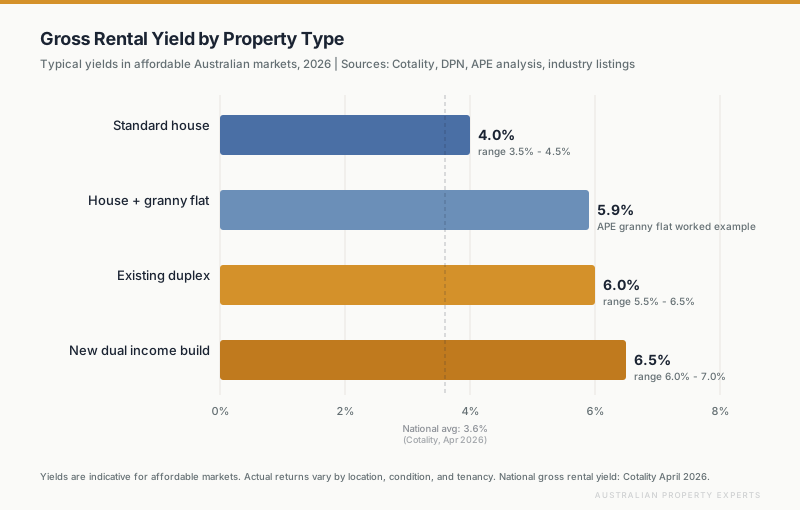
Single dwelling: $550,000 established house, renting for $480 per week. Annual rent: $24,960. Gross yield: 4.5%.
Dual income (existing duplex, same area): $720,000 for two three-bedroom dwellings on one lot. Side A rents for $450 per week. Side B rents for $430 per week. Combined: $880 per week. Annual rent: $45,760. Gross yield: 6.4%.
That 1.9 percentage point gap means $20,800 per year in extra rental income on a property that cost $170,000 more. The weekly position after holding costs is worth running in the cash flow calculator.
For context, Cotality’s Home Value Index puts the national gross rental yield for dwellings at 3.8% at 31 August 2026. Outside Darwin (6.3%), no capital city averages 5%. Hobart is next best at 4.4%. The dual income example above clears 6%, well above the national average.
There is a vacancy buffer built in. If one tenancy sits empty for three weeks during turnover, the other side still pays rent. On a single dwelling, the same vacancy is a full loss. That partial income protection matters more than most investors realise until they sit through their first four-week gap on a single-tenancy property.
Buy Existing or Build New
Two pathways in. Each has a different cost profile.
Buying existing is the faster route. Established duplexes and dual occupancy properties trade on the open market in most capital cities and regional centres. Prices vary widely by city and by how close in you buy. Either way, two dwellings generate rental income from settlement day. The downside: older properties carry lower depreciation and may need renovation on one or both sides.
Building new costs more upfront but delivers higher depreciation and modern layouts that command stronger rents. Construction costs swing widely with state, specification and site conditions. Get fixed-price quotes on the actual plans before you run the numbers.
The depreciation gap is significant. A case study from DPN, a builder that sells new dual income homes, compares two $850,000 properties. The new dual income home delivers $28,000 in depreciation, against $10,000 for a five-year-old house. Two kitchens, two bathrooms, and double the plant and equipment drive the difference. At a 37% marginal tax rate, that $18,000 gap returns an extra $6,660 per year in tax refunds.
New builds also sit in a protected category under the May 2026 Federal Budget changes. From 1 July 2027, losses on established residential investment properties purchased after budget night will only be deductible against other residential property income. New builds keep full negative gearing against all income and can still choose the 50% capital gains tax discount. What legally counts as a new build is still being settled.
One warning on developer-packaged dual key products. When a developer bundles build cost, land, and their margin into a single price, the combined figure often exceeds the property’s independent valuation at completion. Get an independent valuation before committing to any turnkey dual income purchase.
Zoning Rules by State
Council rules determine whether dual income is even possible on a given site. Every state is different.
NSW: Dual occupancies have been permitted in R2 low-density zones across NSW since July 2024. From February 2025, the Low and Mid-Rise Housing Policy set a 450 sqm minimum lot and 12-metre width in designated Low and Mid-Rise Housing areas. Four councils are excluded: Hawkesbury, Blue Mountains and Wollondilly for bushfire, flood and evacuation risk, and Bathurst for a lack of suitable land. The complying development pathway can approve a compliant design within 20 days.
VIC: Amendment VC288 (from 16 October 2025) opened the VicSmart fast-track pathway to two homes on a lot that meet all the relevant standards. Decisions take 10 business days and applications are not advertised. Heritage or flood controls can knock a site out of VicSmart, and lot size rules still vary by council.
QLD: Rules for secondary dwellings differ between councils, so check with yours first. An amendment on 26 September 2022 removed restrictions on who can live in a secondary dwelling, making rentals to non-family tenants legal across the state.
WA: Compliant granny flats up to 70 sqm have not needed planning approval since mid-April 2024. Full dual occupancy requirements vary by local scheme. Perth’s vacancy rate sat at 0.6% in August 2026 (SQM Research). That makes it one of the tightest rental markets in the country and a strong state for this strategy.
SA: Maximum granny flat size increased from 60 to 70 sqm in November 2024. Self-contained granny flats can now be rented to anyone, and those tenants have the same rights as any other renter. Adelaide’s vacancy rate of 0.6% in August 2026 (SQM Research) makes SA attractive for dual income investors.
Before committing to a site, get a planning pre-assessment from the local council. A pre-DA meeting costs little next to buying a block that can’t be approved.
Where They Fit in a Portfolio
A dual income property is not a first purchase for most investors. On property one, the priority is capital growth and the equity engine that funds property two. A single established house in a strong growth market does that job better because it has broader resale appeal and more predictable capital appreciation.
The sweet spot sits around properties three to five. At this stage, portfolio holding costs start to bite. Multiple interest-only loans, multiple sets of rates and insurance, and tighter serviceability at the bank. A dual income property generating $880 per week instead of $480 changes the cash flow picture enough to keep expanding.
The choice between a dual income purchase and adding a granny flat to an existing holding depends on available capital. A granny flat needs far less capital and adds yield to a property you already own. A dual income property puts a full purchase price, $720,000 in our example, into a standalone asset with built-in yield from day one. Different capital requirement, different portfolio position, same goal: more rent per dollar of land. For the full portfolio sequence, see our guide on how to build a property portfolio from scratch.
Three Risks to Size Up
Thinner resale market. Dual key properties and single-title dual occupancy sell to investors only. Owner-occupiers took about 62% of new home lending by value in the June quarter 2026 (ABS), and they are not in the market for them. This limits the buyer pool at exit and can mean longer time on market with less competitive bidding. A Torrens-titled duplex avoids this problem because each dwelling sells independently to any buyer type.
Concentrated capital. A dual income property puts $720,000 of exposure in one location where two $400,000 houses would spread it. Diversification across two locations, two tenant pools, and two market cycles is harder when the capital is locked in one block. The yield is higher, but the geographic concentration is a real trade-off.
Management complexity. Two tenancies, two leases, two sets of maintenance. If both tenants leave in the same month, you cover expenses on a more expensive asset with zero income. Model vacancy at 3% to 4% per tenancy in your cash flow projections, not per property.
A Mid-Portfolio Play That Pays
A dual income property earns its place in a portfolio that already has a growth foundation. The yield uplift is real. Cotality puts the national gross rental yield at 3.8%. Our dual income example clears 6%. The cash flow difference between $480 a week and $880 a week is the difference between stalling at three properties and pushing through to five.
Get the property type right: a subdivided duplex over a single-title dual key where possible. Get the zoning right: check before you commit capital. Get the timing right: mid-portfolio, not day one. The numbers will do the rest.
Sources
- Cotality, Home Value Index September 2026 (data to 31 August 2026)
- SQM Research, residential vacancy rates, Perth and Adelaide (August 2026)
- ABS, Lending Indicators, June quarter 2026
- budget.gov.au, Budget 2026-27 tax reform
- NSW Planning, Low and Mid-Rise Housing Policy key provisions
- NSW Planning, Low Rise Housing Diversity Code
- VIC Planning, faster approvals for two homes on a lot (VC288)
- Planning QLD, secondary dwellings
- WA Government, more granny flat exemptions for housing choice
- SA Department for Housing and Urban Development, bigger granny flats
- SA Planning Commission, granny flat reforms
- DPN, tax benefits of a new dual income home
This is general information only and not financial, tax, or credit advice. Speak to a qualified professional before making investment decisions.
See how APE finds high-yield properties in affordable growth markets on our investor page.
If you want help working out whether a dual income property fits your portfolio strategy, book a free discovery call.