A granny flat on an investment property can shift cash flow by close to $5,000 a year. But the build costs $130,000-$250,000 depending on state, and that same capital could fund a deposit on a second property. Granny flats clearly generate income. The harder question is when adding one is the right move.
What It Costs to Build in 2026
A standard 60 square metre two-bedroom granny flat in 2026 runs between $130,000 and $250,000 all-in, on our estimates. That includes construction, site preparation, service connections, and council approvals.
The spread by state (indicative estimates, not quotes):
- NSW: $150,000-$250,000. Sydney labour costs and a more prescriptive approval process push prices up. The complying development (CDC) pathway can approve a compliant granny flat in as little as 20 days. Sites that don’t qualify need a development application through council, where NSW Planning puts the average decision time at 70 days.
- QLD: $150,000-$230,000. Size and approval rules are set council by council. Brisbane allows up to 80 sqm, which opens up larger layouts.
- VIC: $150,000-$250,000. The December 2023 reforms removed the old restriction that limited occupants to dependent persons. A planning permit is no longer required in most residential zones on lots of 300 sqm or more.
- WA: $130,000-$200,000. Since April 2024, compliant granny flats up to 70 sqm need no planning approval, provided they meet local setback rules. Strong rental demand makes WA a good fit for this strategy.
- SA: $130,000-$190,000. Reforms in November 2024 increased the maximum from 60 to 70 sqm. Granny flats can be rented to anyone, including tenants who are not family.
An HIA builder survey in April 2025 found members expected to build 10 times more granny flats in 2026 than in 2022. HIA links the surge to state planning reforms.
Budget builds from $100,000 exist, but cutting corners on a structure that needs to survive inspections and attract tenants for 20 or more years is a poor trade.
Cash Flow: Before and After
The worked example below uses the RBA’s latest average rate for new interest-only investor loans. The rents and running costs are illustrative assumptions.
Without a granny flat: $550,000 established house in a more affordable market. Loan at 80% LVR ($440,000), interest-only at 6.5%, the RBA’s July 2026 average on new interest-only investor loans (table F6). The main house rents for $450 per week.
- Annual rental income: $23,400 ($450 x 52)
- Annual interest: $28,600 ($440,000 x 6.5%)
- Running costs (rates, insurance, management at 8%, maintenance), estimated: $8,000
- Cash flow: -$13,200 per year ($23,400 minus $28,600 minus $8,000)
- Gross yield: 4.3% ($23,400 / $550,000)
After adding a $160,000 granny flat: Funded by equity redraw on the existing property. The new dwelling rents for $350 per week. You can run the same numbers on your own property in the cash flow calculator.
- Combined rental income: $41,600 ($800 x 52)
- Original interest: $28,600
- Additional interest on $160,000 at 6.5%: $10,400
- Combined running costs, estimated: $11,000
- Cash flow: -$8,400 per year ($41,600 minus $50,000 in total costs of $28,600 + $10,400 + $11,000)
- Gross yield on total investment ($710,000): 5.9% ($41,600 / $710,000)
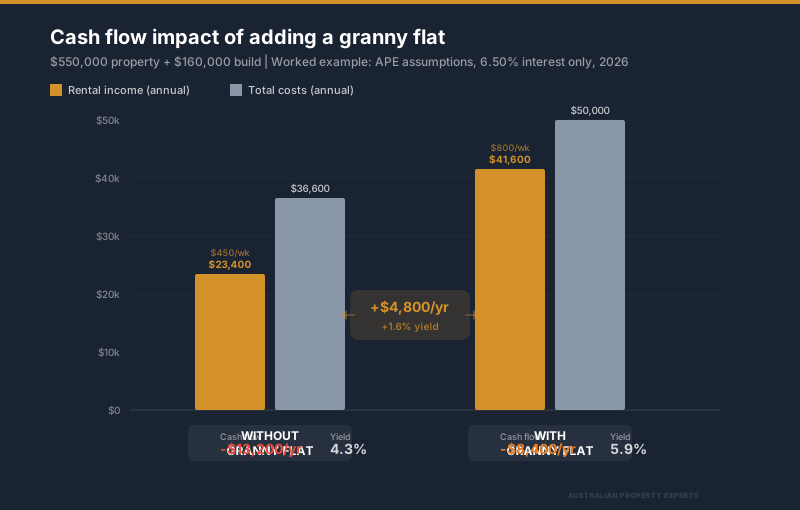
The addition improved cash flow by $4,800 per year ($13,200 minus $8,400). That’s about $92 a week back in the investor’s pocket ($4,800 / 52). It is still negatively geared, but the gap between rent and costs shrank by 36% ($4,800 / $13,200).
Research published in API Magazine in December 2025 drew on InvestorKit data. It found that adding a granny flat lifts a property’s overall rental yield by 1.4 to 1.65 percentage points compared to similar properties without one. The worked example here shows a 1.6 point uplift (5.9% minus 4.3%), inside that range.
There’s a depreciation bonus on top. A new build attracts full depreciation under both Division 43 and Division 40. Division 43 covers the building structure at 2.5% per year for 40 years. Division 40 covers plant and equipment such as appliances, carpets, blinds and the hot water system.
In the first year, expect roughly $5,000-$9,000 in depreciation deductions. BMT’s published average first-year deduction on granny flats is $5,288. A Duo Tax case study on a $130,000 owner build found $7,300 in year one, which scales to roughly $9,000 on a $160,000 build ($7,300 x 160 / 130). At a 37% marginal rate, that’s another $1,900-$3,300 returned as a tax refund, stacked on top of the cash flow improvement.
Because the dwelling is new construction, every fixture is fully claimable under Division 40. That’s the difference from buying a second-hand property, where the 2017 rule change blocks Division 40 claims on existing plant. For more on how depreciation works across a portfolio, see our depreciation schedules guide.
Where the Rent Justifies the Build
Granny flat rental income varies widely by city. The numbers that make the cash flow math work depend on the gap between build cost and local rents.
Perth stands out right now. Rents sit at $400-$600 per week according to Perth builder Summit Homes. Demand is backed by a metro vacancy rate of 0.61% in August 2026 (SQM Research). WA’s population grew 2.1% in the year to March 2026, the fastest of any state (ABS). On a $150,000 build, $450 per week is a 15.6% gross yield on the build cost alone ($23,400 / $150,000).
Adelaide is the other strong market. API Magazine reported in June 2026 that Adelaide granny flats can earn $350-$450 per week. On our estimated build costs of $130,000-$190,000, SA’s planning reforms help the yield maths.
On our estimates, Brisbane middle ring returns $320-$400 per week for a two-bedroom secondary dwelling, with some inner-suburb builds pulling $500 or more. Brisbane’s 80 sqm allowance means you can build a larger dwelling that commands higher rent.
We estimate Sydney’s western suburbs return $350-$420 per week for a two-bedroom, but higher build costs ($150,000-$250,000) compress the yield. The strategy works in Sydney, but the numbers are tighter.
The pattern: affordable markets with low vacancy and strong population growth produce the best returns. The same markets where affordable property outperforms blue-chip.
State Rules at a Glance
Every state has different rules on maximum size and approval requirements. The quick version:
NSW: 60 sqm maximum, or more where the local environmental plan allows it. Minimum lot size 450 sqm. CDC fast-track available on qualifying sites. A granny flat cannot be subdivided or sold on a separate title in NSW. Both dwellings stay on one lot under the Housing SEPP.
QLD: Size and approval rules vary by council (Brisbane allows 80 sqm). Occupancy restrictions were removed statewide on 26 September 2022, so granny flats can be rented to anyone.
VIC: 60 sqm maximum. No planning permit needed on lots of 300 sqm or more in most residential zones since the December 2023 reforms (updated September 2025). Building permit still required.
WA: 70 sqm maximum. No planning approval required for compliant builds since mid-April 2024. Minimum lot size requirements were also removed.
SA: 70 sqm maximum (increased from 60 in November 2024). Self-contained granny flats can be rented to anyone. HIA notes SA confirmed rentals to non-family tenants in October 2023, with tenancies covered by the Residential Tenancies Act like any other rental.
TAS: Currently 60 sqm. A draft amendment to lift the limit to 90 sqm is before the Tasmanian Planning Commission, with a hearing scheduled as at September 2026.
Two trends to watch. Queensland, Victoria and South Australia have all removed the restriction that limited occupancy to family or dependent persons. And maximum floor areas are trending upward, with SA and WA already at 70 sqm and Tasmania weighing 90 sqm.
When to Add One
A granny flat is rarely a first-property strategy. On property one, $160,000 is almost always better deployed as the deposit on a second investment property. The compounding effect of two assets growing in value beats the yield uplift from one property with a secondary dwelling attached.
The sweet spot sits around properties three to five. At this stage, portfolio holding costs are real. Multiple interest-only loans are chewing up income. Adding $350-$450 a week in granny flat rent across two properties can be the difference between stalling at three properties and pushing through to five.
The right candidate: an established house on a block of 450 sqm or more, in a market with strong rental demand and low vacancy. Flat block, good rear access, services (sewer, water, power) running close to where the build will sit. Slope, poor access, and long service runs can add $30,000-$60,000 to the cost and blow the yield maths.
This is the same type of property we source for clients across the portfolio building process: older established houses on decent blocks with optionality. A granny flat is one lever. Cosmetic renovation for equity uplift is another. Which one to pull depends on whether you need cash flow or equity at that point in the portfolio.
What Can Go Wrong
Four common mistakes.
Picking the wrong block. Most of the cost surprises are in the ground, and they are visible before you exchange. Our granny flat site checklist runs the nine checks.
Overcapitalising. A $250,000 build on a $500,000 property in a weak rental market. If it rents for $300 a week, that’s 6.2% on the build cost ($15,600 / $250,000). The same $250,000 deployed as a deposit on a second $550,000 property gives you full capital growth exposure on a separate asset. The secondary dwelling wins on yield. The second property wins on total wealth creation over 10 to 20 years.
Wrong site. Sloping blocks need retaining walls. Blocks with poor rear access need crane lifts or manual handling premiums. Long sewer and water runs need trenching. These extras can add $30,000-$60,000 to the build. Assess the site before committing to a design.
Double the management. Two tenancies on one title means two leases, two sets of tenants, two lots of turnover risk. If both vacate in the same month, you’re covering the full hold cost on a property that now has higher expenses than it did before the build. Factor vacancy at three to four weeks per tenancy per year into your cash flow model before committing.
Turnkey granny flat packages promising guaranteed returns deserve the same scrutiny as off-the-plan property. Get independent quotes. Get an independent rental appraisal from a local property manager as well as the builder’s estimate.
Not a First Move
A granny flat works when three things line up: the right block, the right rental market, and the right stage of your portfolio. The payoff is a 1.4-1.65 percentage point yield uplift and $5,000-$9,000 in first-year depreciation deductions. Add close to $5,000 a year in cash flow improvement on a single property.
Get the timing wrong, and you’ve sunk $160,000 into a build that would have done more as the foundation for your next purchase. A granny flat is also only one way to run two incomes off one title. Our guide to dual income property investment covers duplexes and dual-key stock alongside it.
Sources
- Granny flats set to take off, HIA builder survey
- Why multigenerational living is becoming a smart property investment strategy, API Magazine
- Granny flats boost performance, InvestorKit
- Adelaide’s unlikely emergent boom sector as investors pivot to cash flow in 2026, API Magazine
- Renting out a granny flat in 2026: Perth rules, tips, and realistic income expectations, Summit Homes
- Residential vacancy rates, Perth (August 2026), SQM Research
- Lending rates, table F6, Reserve Bank of Australia
- Granny flats (secondary dwellings) complying development, NSW Planning Portal
- Small second dwellings, VIC Department of Transport and Planning
- Revised R-Codes now in effect, WA Government
- Bigger, more accessible granny flats, SA Department for Housing and Urban Development
- SPP Amendment 01/2026: secondary residences, Tasmanian State Planning Office
- AM-SPP-01-2026 assessment status, Tasmanian Planning Commission
- Complying development, NSW Department of Planning
- National, state and territory population, ABS
- New granny flat built by owner, Duo Tax case study
- A goldmine in your own backyard: granny flat depreciation, BMT
This is general information only and not financial, tax, or credit advice. Speak to a qualified professional before making investment decisions.
If you want the numbers run on your next purchase, see how we invest with data, not postcode bets.
If you’re weighing up whether a granny flat or a second property is the better next move, book a free discovery call.


.jpg)