Land tax is the holding cost most investors forget to plan for. Stamp duty gets all the attention at purchase, but land tax is the one that compounds every year as your portfolio grows. You can reduce land tax on investment property by hundreds or thousands a year through how you structure your purchases across states.
Every state calculates land tax independently. They aggregate the land value of all your investment properties within that state, then apply a progressive rate to the total. Two properties in one state share a single threshold. Two properties in different states each get their own. This is the single biggest lever most investors have for reducing their annual land tax bill. It costs nothing to use.
How Land Tax Aggregation Works
Each state’s revenue office adds up the unimproved land value of every investment property you own in that state. Your principal place of residence is exempt everywhere, but everything else counts: investment properties, vacant land, holiday houses.
The tax is calculated on the aggregated total, not property by property. If you own two properties in Queensland with land values of $300,000 each, the revenue office assesses one total of $600,000 rather than two separate amounts of $300,000.
This matters because every state uses progressive rates. The more land you hold in one state, the higher the marginal rate. A third or fourth property in the same state adds to that total, so more of your holding is taxed at the higher marginal rates.
The thresholds vary dramatically. For the current rates:
| State | Tax-free threshold |
|---|---|
| NSW | $1,075,000 (frozen from 1 January 2025) |
| SA | $936,000 (2026-27, indexed annually) |
| QLD | $600,000 (individuals) |
| WA | $300,000 |
| TAS | $125,000 |
| VIC | $50,000 |
| ACT | No threshold |
| NT | No land tax |
For a full breakdown of rates and surcharges by state, see our land tax by state guide.
The Multi-State Saving in Dollars
Take two investors who each own four properties with a land value of $350,000 each.
Investor A concentrates in Queensland. Four properties aggregated at $1,400,000. That is $800,000 over the $600,000 individual threshold. Queensland’s rate hits 1.65% above $1,000,000.
Annual land tax: $11,100.
Investor B spreads across four states. One property in Queensland ($350,000, under the $600,000 threshold, zero tax). One in NSW ($350,000, under the $1,075,000 threshold, zero). One in SA ($350,000, under the $936,000 threshold, zero). One in WA ($350,000, just above the $300,000 threshold, $370). That $370 is $300 of land tax plus $70 of Metropolitan Region Improvement Tax. Perth metro land attracts it at 0.14 cents in the dollar above $300,000. Our land tax calculator reports the $300 and leaves out the levy. A Perth metro property costs slightly more than the tool shows.
Annual land tax: $370.
On the same portfolio value and number of properties, the annual difference is $10,730. Over a ten-year hold, that is $107,300 in land tax savings before you factor in the deductibility.
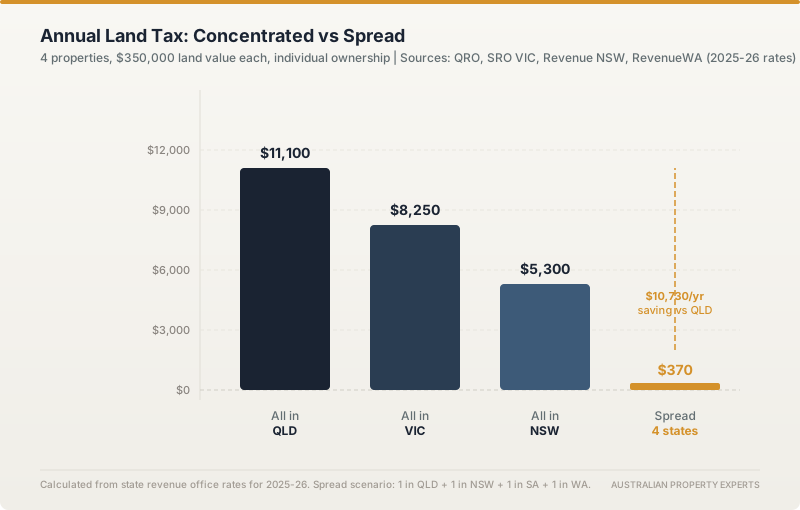
The numbers shift depending on which state you concentrate in. All four in Victoria costs roughly $8,250 per year. All four in NSW costs about $5,300 (once you breach the $1,075,000 threshold). In every case, spreading across states saves thousands annually. Use our land tax calculator to model your own portfolio.
Trust Holders Pay More in Most States
If you hold investment properties in a discretionary trust, the land tax hit is worse in NSW, Victoria, Queensland and South Australia. Spreading matters even more there.
In NSW, a discretionary trust is classified as a “special trust”. It loses the $1,075,000 threshold entirely. Tax applies at a flat 1.6% from the first dollar of land value. A single $350,000 property held individually in NSW pays nothing. The same property in a discretionary trust pays $5,600 per year.
Queensland drops the trust threshold from $600,000 to $350,000 for trusts and companies. South Australia drops it from $936,000 to $25,000. Victoria starts the trust surcharge at $25,000 (versus $50,000 for individuals). It adds an extra 0.375% on top. WA, Tasmania and the ACT charge trusts the same rates as individuals.
For trust holders with a growing portfolio, the aggregation penalty bites earlier and harder. Two properties in NSW held personally might sit comfortably under the $1,075,000 threshold. Two properties in a trust start paying from dollar one. Geographic diversification becomes a holding-cost decision as well as a market-cycle decision.
For a deeper look at when trusts make sense and when they cost you money, see our trust structures guide.
Entity Splitting Won’t Save You
The obvious question is whether you can reduce land tax by spreading properties across different entities within the same state. Put property one in your name, property two in a company, property three in a trust. Each entity gets its own threshold, so each pays less tax.
In theory, it works. In practice, the states have grouping rules and entity rates designed to blunt exactly this.
NSW, Victoria and South Australia group related companies for land tax. If the same people control two companies, the revenue office can assess them as one group. The result is one combined calculation, one threshold, and one larger bill.
Trusts are treated differently in each state. Queensland aggregates land held by one trustee across several trusts when the beneficiaries and their interests are the same. South Australia assesses each trust separately. WA keeps trust land apart from land you own personally. The trust itself then pays the lower trust threshold or surcharge rates covered above.
The fix for high land tax is geographic diversification across real state borders. Restructuring within one state rarely gets you there. Your accountant should confirm the specific grouping rules for your structures before you assume separate thresholds apply.
When QLD Tried Cross-Border Tax
Queensland legislated to fold the value of your interstate land into your Queensland land tax calculation from 30 June 2023. Say you owned $500,000 of land in NSW and $400,000 in Queensland. Queensland would work out the rate as if you held $900,000 in total, then tax only the Queensland share.
The reaction was immediate. The NSW, Tasmanian and Northern Territory premiers said they would not hand over their landholding records. Without those records Queensland would have struggled to enforce it. On 30 September 2022 the Palaszczuk government announced it would not go ahead.
This still gets quoted as if it were current law, but it never took effect. Queensland only assesses land within Queensland today.
But the episode matters for portfolio planning. The political appetite to capture interstate land values exists. If a state faces budget pressure, the QLD playbook is sitting there. NSW chose a different path with the same effect: freezing its threshold so that bracket creep does the work over time. Both approaches increase the tax take from investors without changing the headline rate.
NSW Frozen Threshold and Bracket Creep
From 1 January 2025, Revenue NSW froze both its general threshold ($1,075,000) and premium threshold ($6,571,000). There is no annual indexation. South Australia indexed its 2026-27 thresholds up by 12.44%, while NSW’s line does not move.
As land values rise, a portfolio sitting comfortably under the threshold today can cross it without the investor buying a single new property. Land values rise, the threshold stays fixed, and the gap closes on its own. Take investors buying interstate with NSW already in the portfolio. The frozen threshold means your NSW land tax bill can start from zero and then grow every year without any action on your part.
SA’s annual indexation is the opposite model. The threshold moves with land values. That softens bracket creep over time and makes SA one of the gentler states for land tax if you hold several properties there.
Which State to Add Next
Growth and yield should still decide where you buy. But when two markets are comparable on the numbers, land tax should tip the balance. A property in SA with the same growth profile and yield as one in Victoria costs less in land tax at every portfolio size. The gap runs to thousands a year as the portfolio grows.
The practical order: stay under each state’s threshold as long as possible. Every new state you enter gives you a fresh tax-free threshold. Property one in Queensland (threshold $600,000). Property two in SA (threshold $936,000). Property three in NSW ($1,075,000). Property four in WA ($300,000, lower threshold but low rates). At four properties across four states, you could hold $2,800,000 in combined land value and pay under $500 in total annual land tax.
The Northern Territory does not levy land tax at all. For investors already concentrated in higher-tax states, a Darwin purchase removes one property from the aggregated pile entirely. That does not make Darwin a default buy, but it is worth knowing when comparing markets.
Our free land tax calculator compares your bill across all states for individuals, trusts, SMSFs, and companies.
Use the calculator →
The Holding Cost You Can Control
Most holding costs are fixed. With council rates, insurance and management fees, you pay what the market charges. Land tax is the one you can actively reduce through how you build the portfolio.
The investors who discover this at property three or four, after the bill arrives, have already lost years of savings. The ones who plan for it from property one, buying across states and staying under thresholds, compound that advantage every year they hold.
We buy across every Australian state for our clients, because the best market moves from city to city over time. Land tax is one more reason to spread a portfolio across states.
Land tax thresholds and rates re-checked against each state’s revenue office on 26 September 2026. Land tax assessment dates differ by state (31 December in NSW and VIC, 30 June in QLD and WA). Confirm all figures with the relevant state revenue office or your accountant before acting.
For the upfront half of the equation alongside the annual one, see our ten-year comparison of stamp duty and land tax by state.
Sources
- Land tax figures in this post are produced by our own land tax calculator, whose brackets, thresholds and entity rules are checked against each state revenue office.
- Metropolitan Region Improvement Tax, Government of Western Australia for the 0.14 cents in the dollar levy above $300,000 on Perth metropolitan land.
- Thresholds current for the 2026-27 assessment year. NSW froze its general and premium thresholds from 1 January 2025.
This is general information only and not financial or tax advice. Speak to a qualified professional before making investment decisions.
If you want to understand how land tax affects your next purchase, book a free discovery call.