A property investment strategy is the plan for what you buy, how you pay for it and what the property needs to do for you. Some strategies aim for growth or rent. Others add value through work on the property itself.
Each one solves a different problem, so the right one depends on where your portfolio is up to. Most portfolios use more than one over time. I’ve bought 300+ investment properties for clients across every state. Below are the eight strategies that come up most and the stage where each one fits.
Property investment strategies compared
The table sums up all eight. Each one has its own section below.
| Strategy | What it does for you | When it fits |
|---|---|---|
| Buy and hold | Growth and rent over 10 years or more | From your first purchase |
| Positive gearing | Rent covers the holding costs | When borrowing capacity is the limit |
| Negative gearing | A tax deduction on the loss, with new limits from July 2027 | When your income can carry the shortfall |
| Cosmetic renovation | Lifts the value and the rent | When you buy a tired house in a good street |
| Granny flats and dual income | Two rents from one block | From about the fifth property |
| Subdivision | A second title from one block | Much later, with equity and time to spare |
| Rentvesting | Rent where you live, buy where the numbers work | Before buying a home, or instead of it |
| Commercial property | Long leases, outgoings often paid by the tenant | Much later, on a solid residential base |
1. Buy and hold in affordable markets
Buy and hold is the base of almost every portfolio. You buy an established house, rent it out and keep it for 10 years or more. Growth builds the equity for your next purchase. The rent covers most of the cost of holding it while you wait.
We buy for both growth and yield, in affordable markets rather than blue-chip suburbs. More affordable markets usually yield more. The lower-priced end has often grown faster as well. Our affordable vs blue chip analysis tests that on Cotality’s price-tier data.
Over the 12 months to September, regional dwelling values rose 5.6% while the combined capitals fell 1.8%, according to Cotality’s Home Value Index. Darwin, the most affordable capital, was up 11.9%. Sydney, the dearest, was down 7.0%.
Values have fallen for six months in a row nationally. Across the capitals, the number of homes for sale is 23.1% higher than a year ago. They’re taking a median of 39 days to sell, up from 23. Cotality’s Tim Lawless says the extra stock “is improving choice for buyers”. In our experience, quieter markets also leave more room to negotiate on price.
We also stick to older houses on decent blocks. More land gives you more options later, such as a granny flat or a subdivision. For one client, we bought a house in WA for $355,000 that settled in June 2023. It was valued at more than $690,000 in March 2026. Equity like that can fund the next deposit. Our equity recycling guide shows how.
2. Positive gearing for cash flow
A positively geared property earns more in rent than it costs to hold, interest included. It puts money in your pocket each week. The rent also counts towards your borrowing capacity with the bank.
On a loan, it’s hard to find right now. Even at 3.85%, the highest national gross yield since August 2019 on Cotality’s figures, rent rarely covers the interest. Capital city dwelling yields range from 3.4% in Sydney to 6.5% in Darwin. Cotality says opportunities for neutral to positive cash flow “remain low”. To work out the yield your own loan needs, see what counts as a good rental yield.
Positive gearing helps most once borrowing capacity is what’s holding you back. That usually happens around the second or third property. The serviceability wall covers what to do about it. A house that pays its way but never grows leaves you no equity for the next deposit.
3. Negative gearing for growth
A negatively geared property costs more to hold than it earns. The loss reduces your taxable income, so the tax saving covers part of the shortfall while you wait for growth. It suits people on higher incomes who can carry the gap each week. Depreciation can add to the deduction, though an older house with no renovations may have little to claim. The depreciation calculator estimates it for your property.
For an established property bought after budget night (7:30pm on 12 May 2026), losses from 1 July 2027 can no longer be offset against your salary. They’re pooled against income from your other residential properties, carried forward, and can be used against future residential capital gains. Properties you owned or had exchanged on before that cutoff keep negative gearing for as long as you hold them. New builds keep it too, but we still avoid them for the growth reasons in new build vs established.
This makes yield matter more. A property that’s close to paying its own way builds up a smaller loss to carry forward. Our 2027 negative gearing and CGT guide works through the numbers. Speak to your accountant about how the rules apply to you.
4. Cosmetic renovation for equity
A cosmetic renovation lifts the value and the rent without touching the structure. That means paint, flooring, lighting, or a kitchen or bathroom update. Once the work is done, the bank can revalue the property and you can borrow against the higher figure. The usable equity calculator shows how much that frees up.
We stick to cosmetic work. Structural renovations need permits and engineers, which eat into the margin. Flips lose more again to stamp duty and selling costs. Our cosmetic renovation guide covers where the money goes furthest.
5. Granny flats and dual income
A granny flat or a dual income property puts two rents on one block. The second rent lifts the yield on the whole property. It also lifts the cash flow on a portfolio that’s already a few properties deep.
Keep the build modest. A premium granny flat can cost more than the extra rent will ever justify. The rules on second dwellings vary by state and by council, so check the site before you buy. Our granny flat site checklist has nine checks. The granny flat cash flow maths shows when one pays off. For duplexes and dual-key homes, see dual income property investment.
6. Subdivision and small developments
Subdivision splits one block into two titles, so you can sell or build on the new lot. It can add a lot of value, but it ties up equity and time. Approvals often take longer than planned.
That’s why it belongs much later in a portfolio, once you have equity to spare and a cash buffer. Buying an older house on a bigger block keeps that option open.
7. Rentvesting
Rentvesting means renting where you want to live and buying an investment where the numbers work. It suits you if you live in an expensive city. Sydney’s median dwelling value was $1,198,596 at the end of September. A first home there takes a large deposit and earns no rent. The same deposit can buy an investment elsewhere that grows and earns rent from day one.
Capital gains tax applies when you sell, since the property was never your home. Buying an investment first usually ends your eligibility for first home buyer grants and concessions, so check your state’s rules. Rentvesting in Australia covers how it works in 2026.
8. Commercial property
Commercial property is a different market. Leases often run for years, and a tenant on a net lease usually pays most of the outgoings. Yields have been well above residential ones, though empty periods can last longer. Both vary a lot by sector.
It comes much later in most portfolios, once you have a residential base that can carry an empty period. Our commercial buyers agent page compares commercial and residential yields and has vacancy rates by sector.
Which strategy fits each portfolio stage
Each stage of a portfolio runs into a different limit, so the strategy changes as you go. This is the order we usually follow with clients.
- Properties one and two. Established houses in affordable markets with both growth and yield, with a cosmetic renovation on at least one where the numbers work. If you own your home, its equity can often cover the deposit, as our home equity guide explains. An interest-only loan early on can keep cash flow up. That’s one to work through with your broker, using our interest only vs P&I guide.
- Properties three and four. Interstate purchases, which spread the portfolio across markets and give you a separate land tax threshold in each state. By now, borrowing capacity has often started to bite, and higher-yield purchases help. Trust structures usually come up at this point too, set up with your accountant.
- Property five onwards. Granny flats, dual income and dual-key homes, and small blocks of units.
- Much later. Development and commercial property.
Rentvesting can sit in front of all of this if you’re priced out of buying a home where you live.
The 1% rule on Australian yields
The 1% rule comes from the US. It says a property’s monthly rent should be at least 1% of the all-in purchase price. That works out to a gross yield of 12% a year. The 2% rule doubles it to 24%.
Neither fits Australia. No market in Cotality’s October index reaches 12%, whether you look at houses, units or all dwellings. The highest is 8.2%, for houses in regional Northern Territory, which is about 0.68% of the price in rent each month. Sydney houses yield 3.0%, or 0.25% a month.
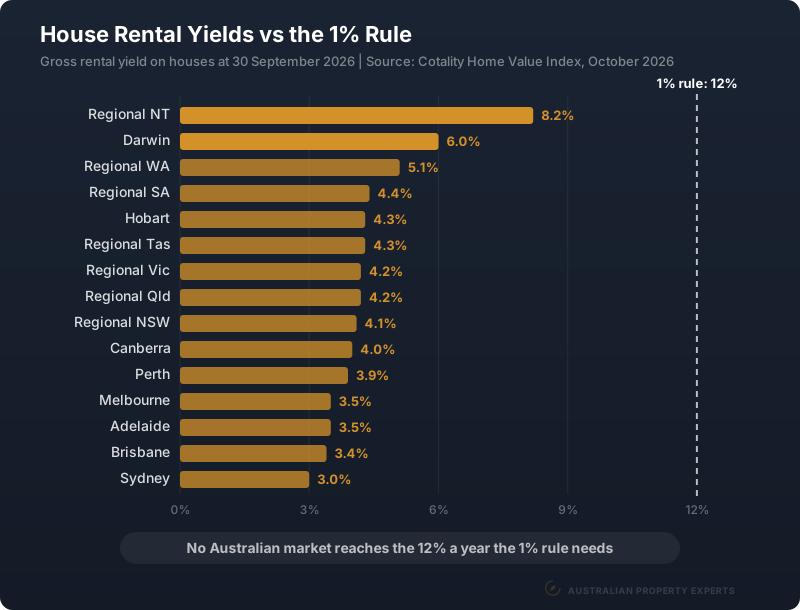
Regional NT houses have a median value of $454,119. At 8.2%, that’s about $716 a week in rent. The 1% rule would want $1,048 a week. Australian prices are high next to rents, so a rule built for US markets doesn’t work here. A better test is the yield your own loan needs, alongside the growth the market has shown.
How to choose your investment strategy
The best property investment strategy is the one that fits your next purchase. For most people starting out, that’s an established house in an affordable market with both growth and yield, held for the long term. The other strategies come in as the portfolio grows and its limits change.
This is general information only and not financial advice. Speak to a qualified professional before making investment decisions.
If you want a strategy mapped out for your next purchase, book a free discovery call.