For an investment property, you’ll usually need a deposit of 10% or 20% of the purchase price. Stamp duty and buying costs come on top. So does lenders mortgage insurance (LMI) if your deposit is under 20%.
On a $500,000 investment property, the total cash ranges from $74,009 to $130,112, depending on your state and deposit size. We worked out what your savings buy in each state using our stamp duty calculator and LMI calculator. For $50,000, $80,000 and $120,000 in savings, you’ll also see which median prices are in reach.
How much deposit you need for an investment property
Most lenders charge LMI when you borrow more than 80% of the property’s value. The insurance protects the lender, but you pay the premium. That’s why a 20% deposit is the usual target. Many lenders will lend up to 90% if you pay LMI, which halves the deposit. Limits vary by lender. Macquarie caps investment loans at 90% if your repayments pay down the loan. If you only pay the interest, it stops at 80%.
A 15% deposit sits in between. On $500,000, it roughly halves the LMI, from $8,429 at a 10% deposit to $4,118 on indicative rates.
Borrow more than 85% and lenders often want proof of genuine savings. Macquarie’s guidelines, for example, ask for 5% of the price, saved or held for at least 3 months. A gift counts once it has sat in your account that long.
After the deposit, stamp duty is the biggest cost. Every figure in this post uses full investor stamp duty, at 2026-27 rates. First home buyer concessions and the 5% Deposit Scheme only apply to a home you live in.
You also pay for conveyancing, a building and pest inspection and loan fees. We allow $3,500 for those. The state charges a fee to register the transfer and your mortgage as well. At a 10% deposit, the LMI premium comes on top. Every state except NSW and the ACT charges insurance duty of 9% to 11% on it.
On a $500,000 purchase, the total comes to about 23% to 26% of the price with a 20% deposit. With a 10% deposit, it’s about 15% to 18%. Keep a buffer on top for vacancies and repairs, ideally 3 to 6 months of repayments and running costs.
Cash needed for a $500,000 investment property
These are the totals for a $500,000 investment property in each state and territory.
| State | Total cash, 10% deposit | Total cash, 20% deposit |
|---|---|---|
| ACT | $74,009 | $115,580 |
| NSW | $78,981 | $120,552 |
| QLD | $80,599 | $121,411 |
| WA | $81,077 | $121,805 |
| TAS | $81,444 | $122,172 |
| NT | $87,063 | $127,791 |
| VIC | $89,246 | $129,974 |
| SA | $89,468 | $130,112 |
In Queensland, the 10% total breaks down like this:
- Deposit: $50,000
- Stamp duty: $15,925
- LMI: $8,429
- Insurance duty on the LMI: $759
- Transfer and mortgage registration: $1,986
- Conveyancing, inspection and loan fees: $3,500
- Total: $80,599
Every 10% total includes $8,429 of LMI on the indicative May 2026 rates in our LMI calculator. Premiums vary a lot between lenders. The calculator shows a range of $7,200 to $15,200 for this loan. Get a quote before relying on the 10% totals.
Outside NSW and the ACT, insurance duty adds $759 to $927 on the premium. These totals assume you pay LMI in cash. If your lender lets you add it to the loan on top of its 90% limit, the loan reaches about 92% of the value. Not every lender allows that. Adding it cuts the cash you need by about $8,400 to $9,400. You then pay interest on the premium for as long as you hold the loan.
The states differ mostly because of stamp duty. Victoria charges $25,070 on a $500,000 investment property and the ACT charges $11,400. Registration fees run from $362 in the Northern Territory to $5,282 in South Australia. South Australia has the highest total because of that fee. Our guide to stamp duty by state for investment property explains each state’s rates. The property purchase cost calculator adds up the costs for your own price and state. It includes a buyers agent fee until you switch it off. Without the fee, its Queensland total at a 10% deposit is $82,299, about $1,700 above ours. It adds council and water rates and allows a little more for other costs.
How much investment property your savings buy in each state
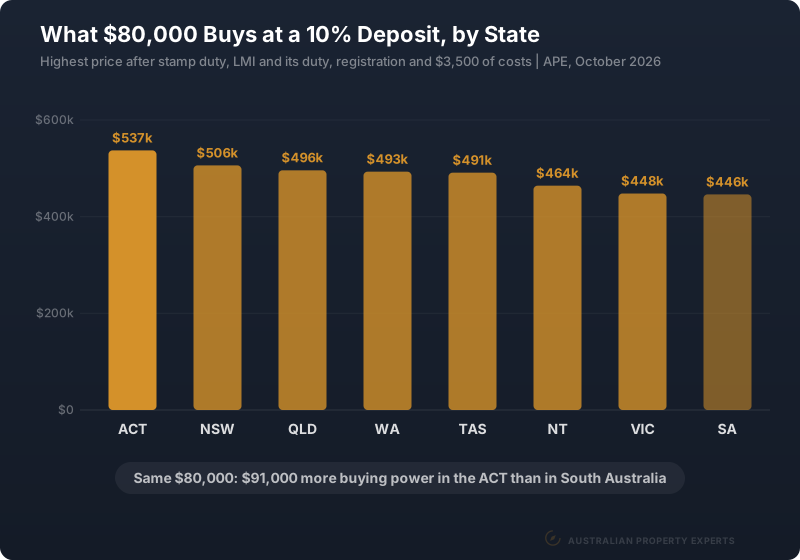
This table shows the highest price you can pay with $50,000, $80,000 or $120,000 saved and a 10% deposit. Each figure allows for the deposit, stamp duty, LMI with its duty, registration fees and $3,500 of other costs.
| State | $50,000 saved | $80,000 saved | $120,000 saved |
|---|---|---|---|
| ACT | $340,000 | $537,000 | $764,000 |
| NSW | $324,000 | $506,000 | $733,000 |
| QLD | $314,000 | $496,000 | $716,000 |
| WA | $318,000 | $493,000 | $713,000 |
| TAS | $311,000 | $491,000 | $717,000 |
| NT | $308,000 | $464,000 | $671,000 |
| VIC | $289,000 | $448,000 | $658,000 |
| SA | $285,000 | $446,000 | $654,000 |
With a 20% deposit and no LMI, the same savings buy less. $50,000 reaches only $190,000 to $215,000.
These figures spend every dollar on the purchase. Set your buffer aside first, then read the column at or just below what’s left. Keep a margin too. If the bank values the property below the price, you’d need more cash.
The medians in the next sections come from Cotality’s October 2026 Home Value Index, with values at 30 September. Cotality was formerly CoreLogic.
Buying an investment property with $50,000 saved
None of the areas in Cotality’s report has a median under $340,000. That’s the most $50,000 buys in any state. The report lists the capitals, each state’s regional market and the fastest-growing regional areas in each state. The lowest median is Charters Towers-Ayr-Ingham in north Queensland, at $381,253 across houses and units.
So at this budget you’re buying below the median of every area the report lists. That often means a unit, or a house in a smaller regional town. A low price can hide a weak market. Check the sales history and rental demand before you commit.
Buying an investment property with $80,000 saved
After each state’s stamp duty and fees, $80,000 covers the median house in regional Northern Territory ($454,119). It also covers the median unit in regional South Australia ($433,183) and Western Australia ($444,348). Regional Tasmania’s median unit ($490,897) sits right on the limit, needing $79,978 of the $80,000. Regional Victoria’s median unit, at $460,245, is just out of reach. No capital city median is in reach.
Some of the regional areas where values grew fastest in the year to September also fit this budget. Cotality’s list includes the Goldfields in Western Australia (median across houses and units $462,470, up 23.8%) and Queensland’s Central Highlands ($415,307, up 17.0%). It also includes Inverell-Tenterfield in New South Wales ($441,382, up 12.4%) and the Grampians in Victoria ($394,201, up 11.7%). Last year’s growth won’t always repeat. Find out what’s driving each market.
With a 20% deposit, the same $80,000 reaches only $307,000 to $347,000. Switching to a 10% deposit costs about $8,300 to $9,100 in LMI and its duty. It lifts what you can buy by $139,000 to $190,000. LMI on an investment loan is generally claimed as a tax deduction over 5 years, or the loan term if shorter. The deduction lowers LMI’s after-tax cost. Some professions, including doctors, lawyers and accountants, can skip LMI with certain lenders, usually up to 90% of the value. Our list of LMI waivers for professionals covers who qualifies at each bank.
Buying an investment property with $120,000 saved
At $120,000 you have two options. You can put down 20% and skip LMI, or put down 10% and take a bigger loan.
With a 20% deposit, $120,000 reaches about $460,000 in South Australia and $518,000 in the ACT. That’s close to what $80,000 buys with a 10% deposit, but you pay no LMI. You also start with a smaller loan and lower repayments.
With a 10% deposit, $120,000 reaches about $654,000 in South Australia and $764,000 in the ACT. That opens up the median unit in Melbourne ($624,740), Hobart ($591,795), Canberra ($582,245) and Darwin ($480,748). Regional units in New South Wales ($681,547) and Victoria ($460,245) fit too. Perth’s median unit ($714,265) is just out of reach. For houses, $120,000 covers the regional medians in South Australia ($578,700) and Tasmania ($646,599).
Darwin’s median house ($747,252) is out of reach. Its median across houses and units, $633,431, fits. Hobart’s median across both, $741,496, is just above the $717,000 you could pay in Tasmania. Every other capital’s median across houses and units stays out of reach, from Melbourne’s $780,550 to Sydney’s $1,198,596.
The more affordable markets often yield more too. Gross yield is a year’s rent as a share of the value. In the same Cotality report, Darwin’s is 6.5% and Hobart’s 4.4%, against 3.4% in Sydney.
Can you buy an investment property with a 5% deposit?
Rarely. Lenders such as Macquarie stop at 90% of the value for an investment loan. The government’s 5% Deposit Scheme only covers a home you live in, as our 5% Deposit Scheme guide explains.
Doctors and dentists are the exception. St.George, Bank of Melbourne and BankSA lend them up to 95% of the property’s value without LMI. All three say this LMI waiver can apply to an investment loan.
A family guarantee is the other route. A parent, sibling or adult child uses their property to secure part of your loan. Westpac accepts one on an investment loan if you don’t own any other property. Otherwise, ask a broker whether any lender goes above 90%.
Using home equity as a deposit for an investment property
If you own a home, you may not need a cash deposit at all. Lenders generally let you borrow up to 80% of your home’s value, less what you still owe on it, without LMI. Equity can cover the deposit and buying costs. The deposit on the contract is due when you sign, weeks before settlement. Arrange the equity loan before making an offer. The usable equity calculator works out your figure.
Our guide to using home equity covers how to set up the loans. For worked examples, see how much equity you need.
How borrowing power limits what you can buy
The bank also has to approve the loan.
New variable investment loans averaged 6.40% in July 2026, the latest RBA figure at 7 October 2026. The RBA lifted the cash rate to 4.60% on 29 September 2026. New loan rates are now higher. Lenders test your repayments at the loan rate plus a 3 percentage point buffer set by APRA, the banking regulator. On July’s average, that’s about 9.4%. The September rise lifts it further.
This repayment test often limits you more than the deposit does. Our guide to how banks work out your borrowing capacity explains it. Ask a broker where your limit sits before you start looking.
This is general information only and not financial advice. Stamp duty, LMI and purchase costs vary by state, lender and your circumstances. Speak to a qualified mortgage broker before making investment decisions.
If you’d like help finding where your deposit goes furthest, book a free discovery call.