Stamp duty in the ACT for an investor is charged in six brackets. The rates run from 1.2% to 6.4% on the part of the price in each. Above $1,455,000 it switches to a flat 4.54% of the whole price. On a $600,000 investment property the duty is $15,720, the lowest of any state or territory at that price.
Home buyers do much better. For contracts from 1 July 2026, owner-occupiers pay no duty if no buyer, or any buyer’s partner, has owned property in the last five years. This guide covers the 2026-27 investor rates and the duty on Canberra’s median house and unit. It also covers land tax, which has no threshold for rentals.
ACT stamp duty rates for investors
| Dutiable value | Investor duty for 2026-27 |
|---|---|
| Up to $200,000 | $1.20 per $100 |
| $200,000 to $300,000 | $2,400 plus $2.20 per $100 over $200,000 |
| $300,000 to $500,000 | $4,600 plus $3.40 per $100 over $300,000 |
| $500,000 to $750,000 | $11,400 plus $4.32 per $100 over $500,000 |
| $750,000 to $1,000,000 | $22,200 plus $5.90 per $100 over $750,000 |
| $1,000,000 to $1,455,000 | $36,950 plus $6.40 per $100 over $1,000,000 |
| Over $1,455,000 | $4.54 per $100 on the total value |
The ACT Revenue Office calls it conveyance duty. The rates are the same as in 2025-26. Each part of $100 counts as a full $100, so the amount over a bracket rounds up.
The transaction date sets the rate. That’s usually the day you sign the contract, not the settlement date.
Stamp duty on a Canberra house and unit
| Purchase price | Investor duty | Share of the price |
|---|---|---|
| $400,000 | $8,000 | 2.00% |
| $500,000 | $11,400 | 2.28% |
| $586,571 (Canberra unit median) | $15,141 | 2.58% |
| $600,000 | $15,720 | 2.62% |
| $800,000 | $25,150 | 3.14% |
| $983,965 (Canberra house median) | $36,006 | 3.66% |
| $1,000,000 | $36,950 | 3.70% |
| $1,500,000 | $68,100 | 4.54% |
Figures are rounded to the nearest dollar. The medians are Cotality’s values for Canberra at 31 October 2026.
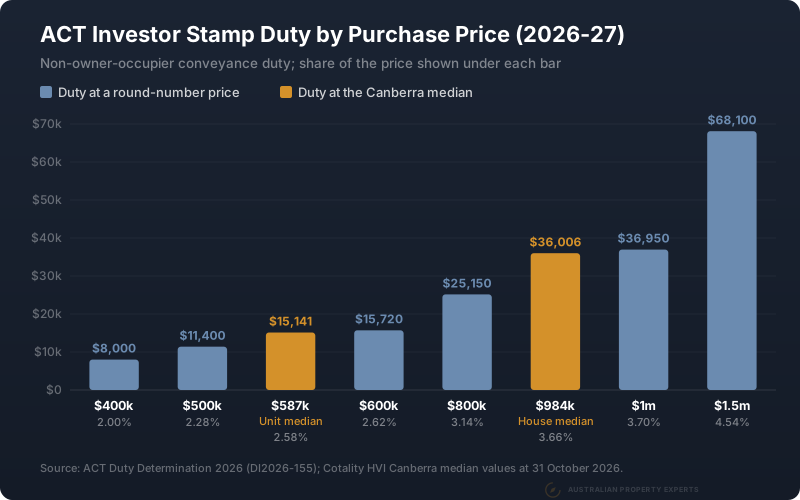
Duty on the median house is $36,006, more than twice the $15,141 on the median unit. The median house sits in the $750,000 to $1 million bracket. There, every extra $10,000 of price adds $590 of duty. Above $1 million each extra $10,000 adds $640.
Of the eight states and territories, the ACT is cheapest at $600,000. Queensland is next at $20,025, then NSW at $21,187 and Tasmania at $22,498. The steep brackets above $750,000 change the order. At $1.5 million, Tasmania, NSW and Queensland all cost less than the ACT. The stamp duty by state guide compares them all.
To run your own price, open the stamp duty calculator set to the ACT.
ACT owner-occupier and investor duty
The ACT has two scales. The one for owner-occupiers starts at $0.28 per $100 up to $260,000, then uses the same marginal rates as the investor scale. Between $300,000 and $1,455,000, an investor pays exactly $2,992 more than an owner-occupier who doesn’t get an exemption. Above $1,455,000 the two are identical.
From 1 July 2026 the Home Buyer Concession Scheme is a full exemption. The income test and the property value limit are both gone. It applies when no buyer, or any buyer’s partner, has owned property in the last five years. At least one buyer has to live in the home as their main residence for a year.
Two other exemptions also give owner-occupiers nil duty from 1 July 2026. One covers off-the-plan units bought to live in. The other covers a newly unit-titled unit bought from the developer by its first occupant.
None of these are open to investors. Every buyer has to be an individual, so a company or trust always pays the investor scale.
ACT has no foreign buyer duty surcharge
The ACT doesn’t add a foreign purchaser surcharge to conveyance duty. The Northern Territory is the only other place in Australia without one.
Foreign owners pay through land tax instead, with a yearly surcharge of 0.75% of the average unimproved value. It’s charged on residential land a foreign person owns, usually on top of ordinary land tax. It doesn’t apply to a home the owner lives in as their principal place of residence.
ACT land tax on rental properties
ACT land tax applies to residential property that isn’t your principal place of residence, including rentals. There’s no threshold. It starts from the first dollar of land value.
For 2026-27 it’s a fixed charge of $1,778 a year plus a rate on the average unimproved value (AUV). That’s the five-year average of the land value.
| Average unimproved value | Rate for 2026-27 |
|---|---|
| Up to $150,000 | 0.54% |
| $150,000 to $275,000 | $810 plus 0.64% over $150,000 |
| $275,000 to $1,000,000 | $1,610 plus 1.24% over $275,000 |
| $1,000,000 to $2,000,000 | $10,600 plus 1.25% over $1,000,000 |
| Over $2,000,000 | $23,100 plus 1.26% over $2,000,000 |
A rented house with an AUV of $350,000 pays $4,318 a year. At $500,000 it’s $6,178. Land tax is billed quarterly, based on how the property is used on 1 July, 1 October, 1 January or 1 April.
For a unit, land tax is worked out on the whole complex’s AUV. It’s then split by unit entitlement, which is each unit’s share on the units plan. Every unit pays the full $1,778 fixed charge. In a four-unit block with equal shares, where the whole site has an AUV of $400,000, each unit pays $2,568 a year.
On a $600,000 rental, the ACT’s duty is $4,305 less than Queensland’s. A unit paying $2,568 a year in ACT land tax uses up that saving in under two years. We modelled duty plus ten years of land tax for every capital in which state costs most to hold.
Why the ACT is phasing out stamp duty
In 2012 the ACT Government began a 20-year program to change how it taxes property. The Revenue Office says the program will abolish duty on property transfers. General rates, the yearly rates bill every owner pays, are rising to make up for it.
Owner-occupiers pay the rising general rates but no land tax. Investors pay both, so for them the reform means less duty at purchase and more to pay every year. Those yearly costs come out of the rent. Put them in your cash flow numbers before you buy.
ACT stamp duty on commercial property
From 1 July 2026, commercial property pays no duty up to $2,100,000. Above that, duty is a flat $5.00 per $100 on the whole value, not just the part over $2,100,000. A property used partly for commercial purposes, such as a shop with a flat above, counts as commercial. Commercial property also pays no ACT land tax.
When stamp duty is paid in the ACT
- Lodging: your conveyancer lodges the transfer with Access Canberra within 14 days of settlement.
- Assessment: the Revenue Office emails a notice of assessment once the title is registered.
- Payment: you pay within 14 days of the notice. There are no payment plans for duty.
Stamp duty isn’t tax deductible. The ATO’s guidance says the duty on the transfer is added to the property’s cost base. The higher cost base reduces the capital gain when you sell. Land tax on a rental is deductible.
Weigh ACT duty against holding costs
The ACT has the lowest investor duty in the country up to about $1.1 million. It also charges land tax on a rental from the first dollar and keeps raising general rates. Before buying in Canberra, put the duty, the yearly land tax and the general rates side by side against the rent. We run these numbers for clients looking at a Canberra investment purchase.
Sources
- ACT Duty Determination 2026 (DI2026-155) for the 2026-27 investor, owner-occupier and commercial rates, and the ACT Revenue Office, conveyance duty for non-commercial property.
- ACT Revenue Office, about conveyance duty for the transaction date, lodgement and payment, and conveyance duty for commercial property.
- ACT Revenue Office, Home Buyer Concession Scheme, the off-the-plan unit duty exemption and the newly unit titled duty exemption.
- ACT Land Tax Determination 2026 (DI2026-152), how land tax is calculated, about land tax and the foreign ownership surcharge.
- ACT Revenue Office, tax reform and about rates.
- ATO, capital gains tax when selling your rental property for stamp duty in the cost base.
- Cotality Home Value Index, November 2026 for Canberra’s median house and unit values at 31 October 2026.
- Duty in other states is from our stamp duty calculator, using each revenue office’s 2026-27 rates. You can also use the Revenue Office’s own conveyance duty calculator.
This is general information only and not financial or tax advice. Speak to a qualified professional before making investment decisions.
If you’re comparing Canberra with other markets for your next purchase, book a free discovery call.