Stamp duty in Tasmania runs from a $50 minimum up to 4.5% of the value above $725,000. On a $600,000 purchase the duty is $22,498. Cotality’s median dwelling value for Hobart at 31 October 2026 was $743,854. The duty on that is $28,661.
Investors and owner-occupiers pay the same scale. Since the first home exemption ended on 30 June 2026, first home buyers pay it too. Foreign buyers pay a surcharge on top. This guide sets out the 2026-27 rates and the duty at common prices. It also covers the land tax that comes after you buy.
Tasmania stamp duty rates for 2026-27
| Dutiable value | Duty |
|---|---|
| Up to $3,000 | $50 |
| $3,000 to $25,000 | $50 plus $1.75 per $100 over $3,000 |
| $25,000 to $75,000 | $435 plus $2.25 per $100 over $25,000 |
| $75,000 to $200,000 | $1,560 plus $3.50 per $100 over $75,000 |
| $200,000 to $375,000 | $5,935 plus $4.00 per $100 over $200,000 |
| $375,000 to $725,000 | $12,935 plus $4.25 per $100 over $375,000 |
| Over $725,000 | $27,810 plus $4.50 per $100 over $725,000 |
This scale has applied since 21 October 2013. A $600,000 purchase today pays the same duty it would have then. Each part of $100 counts as a full $100, so the amount over a bracket rounds up.
On a $600,000 purchase, the duty is $12,935 plus $4.25 for each of the 2,250 lots of $100 above $375,000. That comes to $22,497.50.
Duty is also charged on the higher of the price you pay and the property’s market value. Tasmania’s State Revenue Office (SRO) calls that the unencumbered value. Buying from a relative at a discount doesn’t lower the bill.
Tasmania stamp duty at common prices
| Purchase price | Stamp duty | Share of the price |
|---|---|---|
| $400,000 | $13,998 | 3.50% |
| $500,000 | $18,248 | 3.65% |
| $600,000 | $22,498 | 3.75% |
| $616,155 (regional Tasmania median) | $23,186 | 3.76% |
| $700,000 | $26,748 | 3.82% |
| $743,854 (Hobart median) | $28,661 | 3.85% |
| $800,000 | $31,185 | 3.90% |
| $1,000,000 | $40,185 | 4.02% |
Figures are rounded to the nearest dollar. The medians are Cotality’s dwelling values for Hobart and regional Tasmania at 31 October 2026.
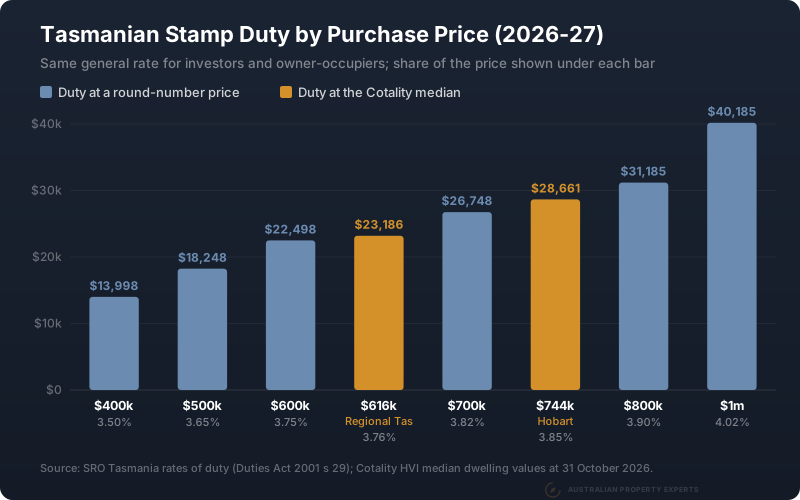
Duty as a share of the price barely changes. It’s 3.50% at $400,000 and 4.02% at $1 million, because the top rate is only 4.5%. To run your own price, open the stamp duty calculator set to Tasmania.
How Tasmania compares with other states
On a $600,000 investment purchase, Tasmania sits in the middle of the eight states and territories. The ACT is cheapest at $15,720, then Queensland at $20,025 and NSW at $21,187. Tasmania’s $22,498 is level with Western Australia’s $22,515.
South Australia, the Northern Territory and Victoria all cost more. Victoria is dearest at $31,070. At $700,000, Victoria’s duty takes 5.3% of the price, against 3.82% in Tasmania.
Tasmania’s 4.5% top rate is the lowest in the country. The dearer the property, the better Tasmania compares. On our calculator it’s the cheapest of the eight at $1.5 million and at $2 million.
We compare all eight in the stamp duty by state guide.
Investors pay the same rate in Tasmania
Everyone pays the one general rate. That includes an Australian resident buying a rental. Some places give owner-occupiers a cheaper scale, the ACT among them. Tasmania’s duty relief schemes for owner-occupiers have all closed:
- First home buyers of established homes: the full exemption up to $750,000 isn’t available for purchases that settle after 30 June 2026. At $750,000 it was worth $28,935.
- Off-the-plan units: the 50% concession closed to agreements signed after 30 June 2026.
- Pensioners downsizing: the 50% concession closed for former homes whose sale settled after 30 June 2025.
The 2026-27 Tasmanian Budget didn’t add new duty relief. Its first home measure was the First Home Owner Grant, for buying or building a new home. The grant was due to fall to $10,000 on 1 July 2026. The Budget set it at $20,000 for 12 months instead.
Tasmania’s 8% foreign buyer surcharge
Foreign persons pay a Foreign Investor Duty Surcharge of 8% of the dutiable value of residential property, on top of the general duty. On a $600,000 purchase that’s another $48,000. The total comes to $70,498.
Anyone who isn’t an Australian citizen, a permanent visa holder or a New Zealand citizen on a special category visa counts as foreign. The SRO presumes every company and trust is foreign until proved otherwise. It also says a discretionary trust with any potential foreign beneficiary is likely to be treated as foreign.
If you’re buying through a company or trust, have the constitution or deed checked before you sign.
Foreign owners also pay a 2% land tax surcharge each year on general land, such as a rental, bought from 1 July 2022. The surcharge can apply even below the usual land tax threshold.
When stamp duty is paid in Tasmania
You pay the duty within three months of the dutiable transaction. That’s usually settlement. If you settle electronically through PEXA, your conveyancer normally pays the duty to the SRO from the settlement funds. The transfer then goes to the Land Titles Office.
Stamp duty isn’t deductible. The ATO’s guidance says it’s added to the property’s cost base, which reduces the capital gain when you sell.
Tasmania land tax after you buy
Tasmania charges land tax on rentals, assessed on land value at 1 July each year. On the SRO’s scale, which has applied since 1 July 2024, there’s nothing to pay on land worth less than $125,000. From $125,000 it’s $50 plus 0.45% of the value above $125,000. From $500,000 it’s $1,737.50 plus 1.5% of the value above $500,000.
A rental on land valued at $300,000 pays $837.50 a year. Add a second Tasmanian property and the two land values are combined and taxed on the same scale. Your home is exempt. Land tax on a rental is deductible each year.
We modelled stamp duty and ten years of land tax for every capital in which state costs most to hold. The land tax comparison by state covers each state’s thresholds.
Budgeting for Tasmanian stamp duty
At the Hobart median, stamp duty adds 3.85% to the price. That’s $28,661. Budget for it with your deposit and the other buying costs from the start.
Duty only moves from 3.50% to 4.02% of the price between $400,000 and $1 million, so buying cheaper barely lowers the rate. Yield and growth matter far more when you choose a market. Our Tasmania buyers agent page sets out what we look for across Hobart, Launceston and the north-west.
Sources
- SRO Tasmania, rates of duty and section 29 of the Duties Act 2001 for the rate table, the per-$100 rule and the 21 October 2013 start date.
- SRO Tasmania, property transfer duties for the three-month payment deadline and PEXA payment.
- SRO Tasmania, first home buyers of established homes duty relief, the off-the-plan apartment or unit duty concession and the pensioners downsizing duty concession.
- Tasmanian Budget Speech 2026-27 for the $20,000 grant.
- SRO Tasmania, Foreign Investor Duty Surcharge rates and definition of foreign.
- SRO Tasmania, rates of land tax and the foreign investor land tax surcharge.
- ATO, capital gains tax when selling your rental property for stamp duty in the cost base.
- Cotality Home Value Index, November 2026 for the Hobart and regional Tasmania median values at 31 October 2026.
- Duty in other states is from our stamp duty calculator, using each revenue office’s 2026-27 rates. You can also use the SRO’s own duty calculator.
This is general information only and not financial or tax advice. Speak to a qualified professional before making investment decisions.
If you’re weighing up a Tasmanian purchase against other markets, book a free discovery call.