Perth and Brisbane have become buyer’s markets. After six years of strong growth, both are now cooling faster than any other capital. Across all the capitals, listings are at their highest for this time of year since 2019. Vendors are giving their biggest discounts since May 2019.
If you’re choosing between the two, the figures below put prices, yields, vacancy and holding costs side by side.
Perth and Brisbane Prices Now
These are Cotality’s Home Value Index figures to 31 October 2026. The percentage changes are for all dwellings, houses and units together.
| Perth | Brisbane | |
|---|---|---|
| Dwelling median | $942,018 | $1,018,401 |
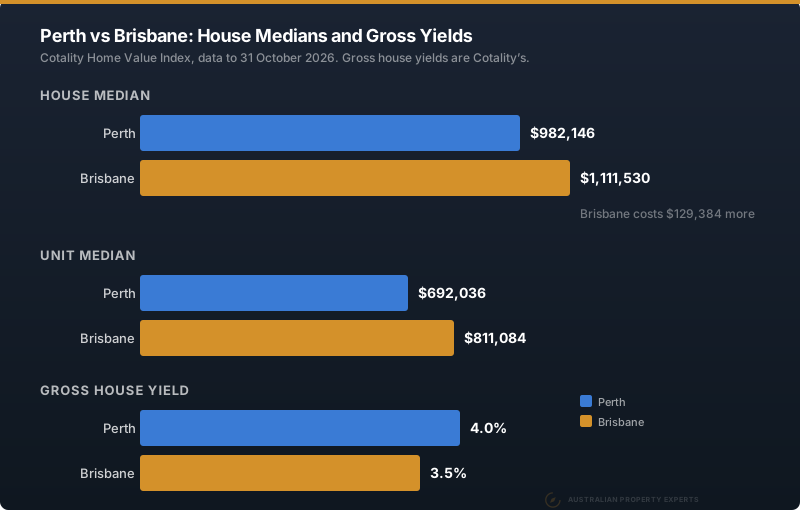
| House median | $982,146 | $1,111,530 |
| Unit median | $692,036 | $811,084 |
| Change in October | -1.7% | -2.0% |
| Change over 3 months | -5.7% | -6.1% |
| Change over 12 months | +3.9% | +0.4% |
| Below peak | 8.9% (April 2026 peak) | 8.3% (May 2026 peak) |
| Change over 5 years | +68.3% | +46.1% |
Source: Cotality Home Value Index, November 2026.
Brisbane’s 6.1% fall over three months is the steepest of any capital. Perth is next at 5.7%. Nationally, values are 6.7% below their March peak. Cotality says capital city values are falling at the fastest pace it has recorded in 40 years.
If you bought in either city five years ago, you’re still well ahead, with values up 68.3% in Perth and 46.1% in Brisbane. Cotality’s research director, Tim Lawless, points out that a 20% drop in Perth values from their record high “would only take the market back to levels recorded in around mid-2025”.
Price and Yield Side by Side
A Perth house costs $129,384 less than a Brisbane house at the median. For units, the gap is $119,048. On a 20% deposit, the median Perth house needs $196,429 and the median Brisbane house $222,306. That’s about $25,900 less cash up front in Perth, before stamp duty and buying costs.
In Perth you also get more rent for every dollar you pay.
| Cotality, October 2026 | Perth | Brisbane |
|---|---|---|
| Gross house yield | 4.0% | 3.5% |
| Gross unit yield | 5.3% | 4.3% |
| House rents, change over 12 months | +7.6% | +6.7% |
| Unit rents, change over 12 months | +6.9% | +6.1% |
Rents are rising while values fall. That’s pushing yields up in both cities.
Say you borrow 80% on an interest-only loan at 6.4%, the average rate on new variable investor loans in September 2026 (RBA table F6). The interest on a median Perth house comes to about $212 a week more than its rent. On a median Brisbane house, the gap is about $346 a week. Perth costs about $134 a week less to hold, or roughly $7,000 a year, before council rates, insurance and management.
We worked out each rent from Cotality’s yield and median. The 6.4% average doesn’t include the rate rises of 29 September and 3 November. At 6.9%, the weekly shortfalls grow to about $287 in Perth and $432 in Brisbane. The cash flow calculator runs the same sums on your own numbers.
Vacancy and Population Growth
SQM Research put Perth’s rental vacancy rate at 0.6% in September 2026 and Brisbane’s at 0.9% (SQM Research). Perth’s has been the lower of the two in every month since the start of 2023.
Brisbane’s city-wide figure blends two rental markets. Postcode 4000, the CBD, sat at 2.4% in September, up from 1.6% in March. Further out, postcodes 4114 around Woodridge, 4300 around Springfield and 4508 at Deception Bay were at 0.5% to 0.6%.
Western Australia’s population grew 2.1% in the year to March 2026, the fastest of any state, against 1.6% in Queensland (ABS). Queensland drew more people from other states, with 14,718 over the year against 10,314 for WA.
Most of WA’s growth lands in Perth. Greater Perth took 88% of the state’s population growth in 2024-25. Greater Brisbane took 59% of Queensland’s, with the rest spread across the Gold Coast, Sunshine Coast and regions (ABS).
Infrastructure in Each City
Perth’s rail build is finished. METRONET opened the Yanchep extension in July 2024, the Ellenbrook Line in December 2024 and the Thornlie-Cockburn Link in June 2025. The new Midland Station, opened in February 2026, was the program’s last rail project (METRONET).
The next big Perth projects are further off. The WA Government puts the Perth Airport redevelopment at more than $5 billion, with a new runway expected in 2028 and a new terminal in 2031. The Westport container port at Kwinana is planned for the late 2030s (Westport). Until those arrive, Perth’s growth depends more on population and jobs than on new transport.
Brisbane’s biggest project is still to come. Cross River Rail’s first passenger services are expected in 2029 (Cross River Rail). It adds four underground stations at Boggo Road, Woolloongabba, Albert Street and Roma Street, plus a new station at Exhibition. It also rebuilds seven suburban stations between Dutton Park and Salisbury. The 2032 Olympics add venue and transport spending across South East Queensland.
Which City Fits Your Portfolio
If your portfolio needs yield, Perth has the stronger numbers. You pay less to get in. The house yield is 4.0% against 3.5%, and the weekly shortfall is smaller. The lower deposit also means you need less equity to fund a first interstate purchase.
If you already own in one of the two cities, the other one spreads your risk. A portfolio held in one state rises and falls with that state’s economy. Perth owners saw this last decade. On the ABS index, prices there fell 14.2% between the June quarter of 2014 and the September quarter of 2019. Holding across two or three states means one state’s downturn doesn’t set the pace for the whole portfolio. Our guide to balancing growth and yield covers how to mix markets.
If you can carry a bigger weekly shortfall through the current fall, Brisbane gives you Cross River Rail in 2029 and Olympic spending ahead.
Through the boom, the cheaper suburbs in both cities grew fastest. In this downturn, Cotality says cheaper and dearer homes in the mid-sized capitals are moving at about the same rate, so a lower price alone won’t protect a property. We buy in the more affordable outer suburbs of both cities. We look for established houses on decent blocks, where a cosmetic renovation or a granny flat can add value later.
What to Check Before You Buy
How far prices could fall. CBA’s economists now expect Brisbane and Perth values to fall about 18% from peak to trough (CommBank). So far, Perth is 8.9% below its peak and Brisbane 8.3%. Falling prices do mean more choice and more room to negotiate. Buy at a price and loan size you could hold if values fall further, with cash set aside to cover the weekly shortfall.
Your borrowing capacity at today’s rates. The cash rate has risen five times in 2026. Lenders test new loans at the actual rate plus a 3 percentage point buffer. Get your broker to re-run the numbers before you search.
Vacancy by postcode. The Brisbane CBD at 2.4% and outer postcodes at 0.5% to 0.6% are different rental markets. Check the vacancy rate for the postcode you’re buying in.
The 2027 negative gearing change. On an established home you exchange on after 7:30pm AEST on 12 May 2026, a rental loss from 1 July 2027 won’t come off your salary. You can only use it against residential rental income or residential capital gains, and anything left over carries forward. New builds keep the existing rules. Read our guide to the 2027 changes, then have your accountant check your position.
Perth or Brisbane on Your Numbers
Perth costs less to buy and less to hold. Its vacancy is tighter too. Brisbane costs more each week, with Cross River Rail and the Olympic spending still ahead. Both are cheaper than they were six months ago and could fall further, so buy at a price your cash flow can hold.
This is general information only and not financial advice. Speak to a qualified professional before making investment decisions.
If you want Perth and Brisbane compared on your own numbers, book a free discovery call.
Sources
- Cotality Home Value Index, November 2026, data to 31 October 2026
- SQM Research National Vacancy Rates, September 2026, and SQM postcode vacancy series
- ABS National, state and territory population, March 2026
- ABS Regional population, 2024-25
- RBA table F6: Lending rates, September 2026
- CommBank economists, house price forecasts, 3 November 2026
- METRONET, Westport timing and Cross River Rail FAQ
- ABS Residential Property Price Indexes