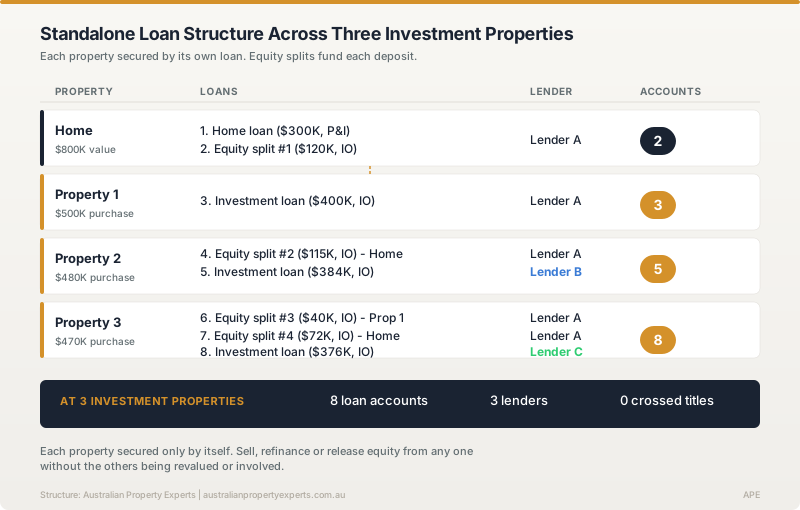
Loan structure can decide whether a property portfolio keeps growing or stalls at property two. By the third investment property, a clean structure can run to eight loan accounts across three lenders. If the loans are set up well, you can sell, refinance or draw equity from any one property without dragging the others in.
The problems usually start at property one. The bank sets the loans up in whatever way is simplest for the bank, and every later purchase is built on top of that.
Separate Loan Splits for Each Deposit
The first purchase usually draws on equity in your home, through three separate loans:
- The home loan, secured by your home. Its interest isn’t deductible, so it’s usually the first debt investors pay down.
- A separate split for the deposit, also secured by your home, used only for the investment’s deposit and buying costs. It’s usually interest-only, so more of your cash can go to the home loan.
- The investment loan, secured only by the investment property, for the other 80% of the price.
Take an $800,000 home with $300,000 owing. Most banks lend up to 80% of the value, which gives a $640,000 limit. That leaves $340,000 of usable equity. A $500,000 investment property needs a $100,000 deposit. Add about $20,000 for stamp duty and buying costs at NSW or Queensland rates. In Victoria or South Australia, the costs run closer to $30,000. So the split is $120,000 for the deposit and costs. The investment loan covers the other $400,000.
The split has to be its own loan account. If the bank adds $120,000 to the existing home loan instead, you have one mixed-purpose loan. The ATO’s ruling on these, TR 2000/2, says you can’t choose to put your repayments against the private part. Every repayment reduces both parts, so the deductible part shrinks along with the home debt. If it’s already happened, refinancing into separate splits stops it getting worse. Your accountant can work out the deductible share.
Our home equity guide covers the deductibility rules in full. The cross-collateralisation guide explains what goes wrong when two properties secure one loan.
Spreading Loans Across Lenders
A second lender helps with property two in three ways. First, no single bank holds every title. With properties at two lenders, you can sell or refinance one without the other bank needing to agree.
Second, some lenders have more room to lend than others. Since 1 February 2026, no more than 20% of a lender’s new investor loans can go to borrowers whose debts are six or more times their income. Your debt-to-income ratio is the same at every bank, but a bank close to that cap is more likely to cut the loan or say no. APRA itself says borrowers can go to lenders that aren’t close to the limit (APRA).
Third, lenders assess you differently. They count rental income, existing debts and living costs in their own ways. One may approve a loan that another declines on the same income.
The deposit for property two usually still comes from your home, through a second split with Lender A. Lender A will value the home again first. If the value has softened, the usable equity shrinks. A $20,000 lower valuation cuts $16,000 from what you can draw. The home is revalued whichever bank lends on property two. The standalone structure stops property one being revalued and pulled into the deal too.
After property two, the loan register looks like this:
| Loan | Secured by | Lender | Purpose |
|---|---|---|---|
| 1. Home loan | Home | A | Private, principal and interest |
| 2. Deposit split 1 | Home | A | Deposit for property 1, interest-only |
| 3. Investment loan 1 | Property 1 | A | 80% of property 1, interest-only |
| 4. Deposit split 2 | Home | A | Deposit for property 2, interest-only |
| 5. Investment loan 2 | Property 2 | B | 80% of property 2, interest-only |
The number of accounts grows with every purchase. By five investment properties, a standalone structure can run to a dozen loans. Keep a register with each loan’s lender, balance, rate, interest-only expiry date and offset balance. Update it after every change.
Using Equity in Investment Properties
From property three, the investment properties can start funding deposits themselves. The bank values the property. It then lends up to 80% of the valuation, less the existing loan.
Say property one cost $500,000 with a $400,000 loan and, a few years on, has grown to $560,000. The bank values it conservatively at $550,000. Eighty per cent is $440,000, so there’s $40,000 to draw through a new split secured by property one.
Property two cost $480,000 and needed $115,000 in cash from a second split on the home, which leaves $105,000 of usable equity there. Property three costs $470,000 and needs $112,000: $40,000 from property one and $72,000 from the home. It adds three more accounts, including an investment loan with a third lender. That’s the eight loans across three lenders in the chart.
Each new split is a new loan. Its interest is deductible only if the money goes into another income-producing purchase. Keep the drawn funds in a separate account. Send them straight to the purchase. The paper trail then shows exactly what the money paid for. The equity recycling guide walks through how this repeats at each stage.
Rental Income and Serviceability
Lenders don’t count all of your rent when they assess a new loan. APRA’s guidance to banks sets a minimum cut of 20%, with larger cuts where vacancy risk is higher. Many lenders count 80% of rent and some count less.
Say your portfolio earns $2,000 a week in rent. A 20% cut counts $1,600 of it and a 30% cut counts $1,400. That $200 a week gap is $10,400 a year of assessed income. It can decide an approval. Our serviceability wall post covers what else helps, from cancelling unused credit limits to picking a lender whose assessment rules suit you.
Which Offset Gets Your Spare Cash
While you still have a home loan, spare cash usually does the most in the home loan’s offset. Home loan interest isn’t deductible, so every dollar of it you save is a full dollar after tax.
This comparison uses the RBA’s average new variable rates for September 2026 (RBA table F6). Owner-occupiers paid 6.2% and investors 6.4%. The cash rate has risen twice since, but the comparison holds. With $50,000 in the home loan offset, you save $3,100 a year in interest. In an investment loan offset, the same $50,000 saves $3,200 in interest. But that $3,200 of interest was deductible, so at a 39% marginal rate, including Medicare, you lose $1,248 in tax savings. The net saving is $1,952. The home loan offset comes out $1,148 a year ahead. Your accountant can run this on your own rates and tax bracket.
Once the home loan is gone, the best offset is the one that saves the most after tax. That depends on each loan’s rate, whose name the property is in and whether that property’s losses can still come off your salary under the 2027 rules below.
Keep personal spending out of your investment loans. A redraw for private use makes the loan mixed-purpose, and it stays that way until you refinance it into separate splits. Taking money out of an offset account is different. It isn’t a new borrowing, because the ATO treats an offset as a deposit account (TR 93/6).
How the 2027 Rules Change the Maths
The interest on an investment loan stays deductible after 1 July 2027. Some rental losses, though, will no longer come off your salary.
The change applies to an established home you exchange on after 7:30pm AEST on 12 May 2026. From 1 July 2027, a rental loss on that property can only be used against residential rental income or residential capital gains. Any loss left over carries forward to later years. New builds, and properties you exchanged on before the cutoff, keep the existing treatment.
A portfolio can end up holding both kinds. That affects which offset to use, whose name the next purchase goes in and how much weekly top-up you can carry. The 2027 playbook goes through each case. Your accountant should work through your own.
What a Refinance Costs
Refinancing moves a loan to a new lender. It’s worth doing when another lender has a better rate or will assess you more favourably. It’s also the way out when your lender won’t release equity.
- Outgoing lender’s discharge fee: $350 at CBA, NAB and Westpac. ANZ charges a $160 lodgement fee and a $160 discharge fee, plus $160 more if it attends settlement.
- State registration: you pay to register both the discharge and the new mortgage. Registering a mortgage alone costs from $129.20 in Victoria to $248.04 in Queensland in 2026-27.
- Incoming lender’s fees: application and valuation fees are often waived, but some lenders charge an establishment fee on refinances.
- Fixed-rate break costs: these can be large if rates have fallen since you fixed. With the cash rate up five times in 2026, a loan fixed before then may cost little to break. Ask the lender for a quote first.
In total, expect roughly $600 to $1,900 per loan before any break cost. A 0.20% rate saving on a $400,000 loan is $800 a year. At that saving, the switch pays for itself in 9 to 29 months.
Allow time as well. NAB asks for at least 10 business days’ notice to discharge a loan. If you’re about to draw equity from a property for a purchase, don’t refinance that property at the same time.
Loan Structure for the Next Purchase
The rate on one loan matters less than whether your structure lets you buy the next property. A slightly cheaper rate that ties two properties to one bank usually costs more than it saves once you need to sell or draw equity from one of them.
The structure that keeps a portfolio growing has each investment property securing its own loan and a separate split for every deposit. As you add properties, the loans spread across lenders. Spare cash sits against the home loan while you have one. Your broker and accountant can check how that fits your own loans.
This is general information only and not financial or lending advice. Loan structure depends on your circumstances and each lender’s policy. Speak to a qualified mortgage broker and accountant before making lending decisions.
If you want your next purchase planned around your loan structure, book a free discovery call.
Sources
- ATO Taxation Ruling TR 2000/2: deductibility of interest on moneys drawn down under line of credit facilities and redraw facilities
- ATO Taxation Ruling TR 93/6: loan offset arrangements
- APRA: activating debt-to-income limits
- APRA Prudential Practice Guide APG 223 Residential Mortgage Lending
- RBA table F6: Lending rates, September 2026
- Lender fee schedules: CBA, NAB, Westpac and ANZ’s personal banking fees and charges, as at November 2026