The ACT doesn’t give investors a land tax threshold. Unless an exemption applies, a rented or vacant home pays from the first dollar of land value. For 2026-27 that’s a fixed charge of $1,778 plus a valuation charge on the property’s average unimproved value.
It’s also charged differently from every state. Each property is taxed on its own value, four times a year. A second rental doesn’t push the first into a higher band.
This guide covers the 2026-27 rates, units and granny flats, the exemptions and when you pay.
ACT land tax rates for 2026-27
The Land Tax Determination 2026 took effect on 1 July 2026. It sets the fixed charge at $1,778. The marginal rates are unchanged from last year.
| Average unimproved value (AUV) | Valuation charge for the year |
|---|---|
| Up to $150,000 | 0.54% of the AUV |
| $150,000 to $275,000 | $810 plus 0.64% above $150,000 |
| $275,000 to $1,000,000 | $1,610 plus 1.24% above $275,000 |
| $1,000,000 to $2,000,000 | $10,600 plus 1.25% above $1,000,000 |
| Over $2,000,000 | $23,100 plus 1.26% above $2,000,000 |
Add the $1,778 fixed charge to get the year’s land tax.
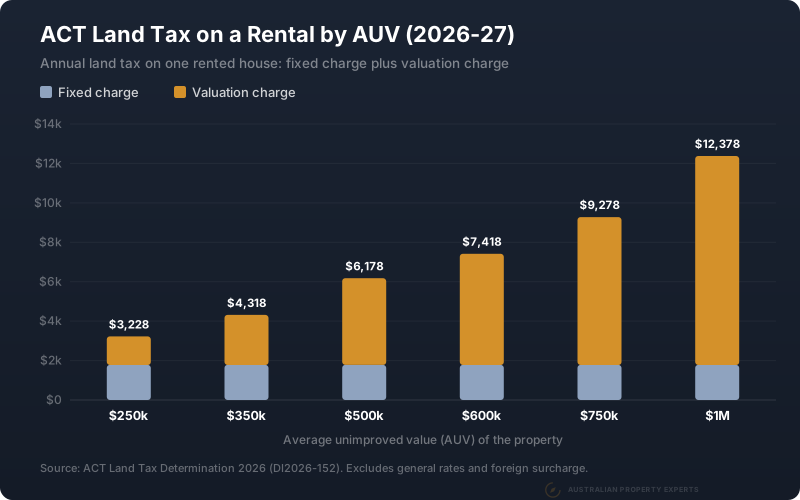
| AUV of the property | Valuation charge | Land tax with the $1,778 fixed charge |
|---|---|---|
| $250,000 | $1,450 | $3,228 |
| $350,000 | $2,540 | $4,318 |
| $500,000 | $4,400 | $6,178 |
| $750,000 | $7,500 | $9,278 |
| $1,000,000 | $10,600 | $12,378 |
Between $275,000 and $1 million of AUV, the rate is 1.24%. Every extra $10,000 of AUV in that band adds $124 a year.
The land tax calculator, set to the ACT, adds the fixed charge for you.
How the average unimproved value works
The ACT usually taxes the average of up to five years of unimproved values, not this year’s value alone. For 2026-27 that’s the average of the 2022 to 2026 values. Newer properties use a shorter average or a single value.
Averaging smooths a single big revaluation. It also spreads a fall over several years. In 2026, residential unimproved values across the ACT rose 1.4%. The average rose 5.4%. The ACT Revenue Office says the gap comes from the large rises after COVID that went into the 2022 values.
Each property is taxed on its own
The Land Tax Act imposes land tax for each quarter on each parcel of residential land. The ACT doesn’t add your rentals together.
Two rented houses with an AUV of $400,000 each pay $4,938 each. That’s $9,876 a year in total. In NSW or Queensland, the same two blocks would be added together and tested against one threshold. In the ACT, each one pays its own bill, fixed charge included.
Land tax on units in the ACT
Units are charged in two steps. First, the valuation charge is worked out on the AUV of the complex’s residential land. Then it’s multiplied by each unit’s unit entitlement, its share on the units plan.
Every rented unit pays the full $1,778 fixed charge. In a four-unit block with equal shares, where the whole site has an AUV of $400,000, each unit pays $2,568 a year. The fixed charge is more than two thirds of that.
The smaller a unit’s valuation charge, the bigger the fixed charge’s share of its bill. Check the unit entitlement and the complex’s AUV before you buy. Our ACT stamp duty guide sets this against the duty you save on a unit.
Granny flats and part-rented homes
If you live in your home and rent out a granny flat, you pay land tax while it’s rented. The tax is a share of the property’s land tax, based on the rented floor area. If the second dwelling isn’t rented, there’s no land tax on it.
If the property isn’t your home, land tax applies to all of it, rented or vacant, unless an exemption applies.
Who pays ACT land tax and the exemptions
Land tax applies to residential property that isn’t the owner’s principal place of residence. That covers rented homes, vacant homes and property owned by a company or held by a trustee. Commercial property doesn’t pay ACT land tax.
The main exemptions are:
- Your home. You’re exempt if you lived in it on the first day of the quarter. Only one owner needs to live there. A couple can only claim one home between them unless they’ve legally separated.
- Moving in. If you buy a home to live in, you have three months from settlement to move in. Don’t rent it in the meantime.
- Moving out. Your old home stays exempt for the first full quarter after you leave, as long as it isn’t rented.
- Rent-free or nominal rent. A home occupied rent-free, or for just enough to cover rates, repairs, maintenance and insurance, is exempt.
- Unfit to live in. A home under construction, being significantly renovated or damaged is exempt while no one can live in it or rent it.
The home, moving and deceased estate exemptions don’t apply to property owned by a company or a trust. Talk to your accountant before you put a Canberra home into one.
Quarterly assessments and when you pay
The ACT assesses land tax four times a year, on the property’s status at 1 July, 1 October, 1 January and 1 April. Each quarter is charged in full. There’s no daily pro-rating.
An investor is liable from the first day of the first quarter after settlement. If your home becomes a rental, you have 30 days to tell the ACT Revenue Office. Late notice is a tax default and can bring interest and penalties.
Each quarter’s share of the annual bill depends on its days. In a non-leap year, the July and October quarters each carry 25.2054%. The fixed charge for the October 2026 quarter is $448.15.
You pay four quarterly amounts by direct debit, card, internet banking or in person. Interest compounds monthly on anything late.
Foreign owners
A foreign person who owns residential land in the ACT pays a surcharge of 0.75% of the AUV each year. It usually sits on top of land tax. On a rental with a $500,000 AUV it adds $3,750. It can apply even when ordinary land tax doesn’t, such as a home let rent-free.
A foreign citizen who lives in the home as their principal place of residence doesn’t pay it. Nor does an Australian posted overseas.
Land tax, rates and duty in Canberra
ACT land tax sits alongside stamp duty and general rates. Stamp duty is paid when you buy. General rates and land tax are paid every year. Land tax starts at the first dollar.
Our post on which state costs most to hold models duty plus ten years of land tax for every capital. Canberra has the lowest duty rate and the highest ten-year total. If you’re weighing a Canberra purchase, we run these numbers against the rent before you commit.
Sources
- ACT Land Tax Determination 2026 (DI2026-152) for the $1,778 fixed charge, the rate table, the quarterly formula and the 0.75% foreign surcharge.
- Land Tax Act 2004 (ACT), section 9, for land tax imposed on each parcel for each quarter.
- ACT Revenue Office, how land tax is calculated for the AUV, quarter shares and units, and about land tax for liability and granny flats.
- ACT Revenue Office, land tax exemptions, frequently asked questions, paying land tax and the foreign ownership surcharge.
- ACT Revenue Office, land valuations for the 2026 changes in unimproved values and AUVs.
- Land tax figures were calculated with our land tax calculator, using the rates above.
This is general information only and not financial or tax advice. Speak to a qualified professional before making investment decisions.
If you’re deciding whether a Canberra rental stacks up after land tax, book a free discovery call.