Western Australia charges land tax once the taxable value of the land you own in the state is more than $300,000. An exempt home isn’t counted. That’s a low threshold, but the rates are low too. A $500,000 block attracts $500 of land tax a year.
Perth investors pay a second tax as well. The metropolitan region improvement tax, or MRIT, adds 0.14 cents in the dollar above $300,000. On that $500,000 block it’s another $280.
Below are the rates, the MRIT rules and what trusts pay. Notices generally arrive between September and January.
WA land tax rates
RevenueWA charges these rates on the aggregated taxable value of your land at midnight on 30 June.
| Aggregated taxable value | Land tax |
|---|---|
| Up to $300,000 | Nil |
| $300,001 to $420,000 | $300 |
| $420,001 to $1,000,000 | $300 plus 0.25% above $420,000 |
| $1,000,001 to $1,800,000 | $1,750 plus 0.9% above $1,000,000 |
| $1,800,001 to $5,000,000 | $8,950 plus 1.8% above $1,800,000 |
| $5,000,001 to $11,000,000 | $66,550 plus 2% above $5,000,000 |
| Over $11,000,000 | $186,550 plus 2.67% above $11,000,000 |
At $300,000 you pay nothing. One dollar more and you pay $300. Everyone uses this one scale.
Individuals, companies and trusts all get the same $300,000 threshold and the same rates.
The metropolitan region improvement tax
MRIT applies to land that is both liable for land tax and inside the Perth metropolitan region. The rate is 0.14 cents for every dollar of aggregated taxable value above $300,000. It’s been set at that level since 2008-09.
The money goes to a fund the Western Australian Planning Commission spends on land for roads, parks and open space.
MRIT has the same exemptions as land tax. If your land isn’t liable for land tax, it doesn’t pay MRIT either. So a home that qualifies for the exemption pays neither. Taxable land outside the metropolitan region pays land tax but no MRIT. RevenueWA’s land tax assessment page links to a map of the metropolitan region.
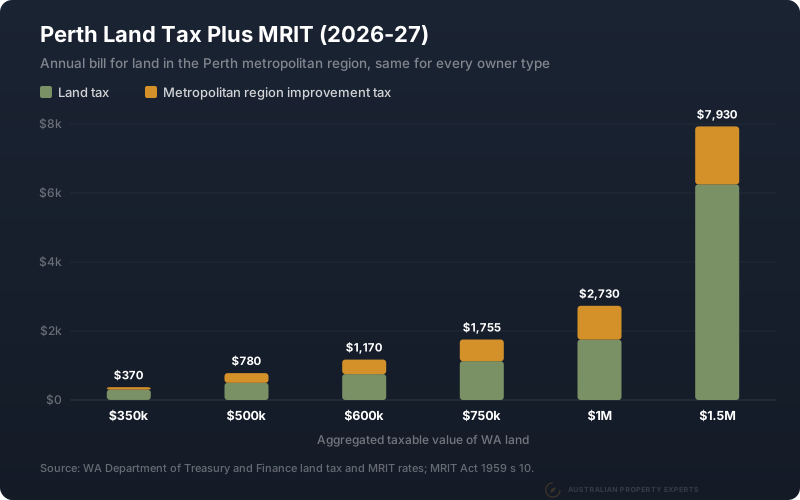
| Aggregated taxable value | Land tax | MRIT | Total each year |
|---|---|---|---|
| $350,000 | $300 | $70 | $370 |
| $500,000 | $500 | $280 | $780 |
| $600,000 | $750 | $420 | $1,170 |
| $750,000 | $1,125 | $630 | $1,755 |
| $1,000,000 | $1,750 | $980 | $2,730 |
| $1,500,000 | $6,250 | $1,680 | $7,930 |
Anywhere from $420,000 to $1 million, MRIT is exactly 56% of the land tax. From $1 million to $1.8 million, land tax rises by 0.9 cents a dollar. MRIT shrinks as a share. At $1.5 million it’s about 27% of the land tax.
The land tax calculator, set to Western Australia, includes MRIT while its Perth metropolitan region switch is on. It’s on by default. Turn it off for land in Bunbury, Geraldton or anywhere else outside the region.
How RevenueWA values your land
Land tax is charged on unimproved value. That’s the land alone, without the house. The Valuer-General sets it.
WA limits how fast your taxable value can grow. It’s the lower of the current unimproved value and 150% of the previous year’s unimproved value. A block revalued from $400,000 to $700,000 is taxed on $600,000 that year. The cap applies to MRIT as well.
If the value looks wrong, object to the Valuer-General through Landgate. Errors in the assessment itself are different. Those go to RevenueWA within 60 days of the notice.
Companies, trusts and joint owners in WA
WA doesn’t add a surcharge for trusts or companies.
What matters is which land gets added together. RevenueWA generally aggregates only land owned by the same owners. Land you own alone is assessed separately from land you own jointly with your partner. A third block owned with your partner and a sibling is a third assessment. Each one gets its own $300,000 threshold.
A trustee is generally assessed separately for each trust. Land held for one trust usually isn’t added to the trustee’s own land, or to land held for another trust. In some cases RevenueWA assesses them together. There’s a catch here. A home the trustee lives in isn’t exempt just because it’s their residence. RevenueWA only exempts it in narrow cases, such as a home held for a disabled beneficiary.
Spreading land across owners changes your land tax. It also changes your finance, stamp duty and capital gains. Work through the structure with your accountant before you buy.
Your home and moving house
Your home is exempt if you own it and live in it on 30 June. It must be your principal place of residence. Partial exemptions apply when only some owners live there, or when part of the land is used for business.
Other exemptions cover moving between homes and building a new one. They also cover a home left after the owner’s death and a move into full-time care. Each has its own conditions and form.
WA land tax dates and payments
- Taxing date: midnight on 30 June. If you sell during the year, you still pay for land you owned on the previous 30 June.
- Notices: generally issued between September and January.
- Pay in full: by the first instalment date and you get a 3% discount.
- Pay in instalments: two or three payments by the dates on your notice, with no extra charge.
- Objections: in writing within 60 days of the issue date. Lodging one doesn’t delay the payment.
A newly subdivided lot is taxed from the 30 June after the subdivision is approved, even before its title is issued.
You can claim land tax on an investment property as a deduction against the rent. Keep each notice with your tax records. Our guide to investment property tax deductions lists the other costs you can claim.
Interstate land and foreign owners
WA land tax counts land in Western Australia. A property in Queensland or South Australia doesn’t push your WA bill into a higher band. Our post on reducing land tax across states shows how that plays out with four properties.
WA doesn’t charge foreign owners a land tax surcharge. Foreign buyers of residential property pay a 7% surcharge on transfer duty instead, with some exclusions.
What a Perth investment property costs in land tax
For a single investment property in your own name, WA land tax is small. A Perth block with a taxable value of $500,000, held on its own, costs $780 a year with MRIT. Holdings past $1 million cost more as the rate rises to 0.9%.
Price both taxes into your cash flow before you buy. We run those numbers for clients buying in Perth. The land tax comparison by state shows how WA compares with the other states.
Sources
- Department of Treasury and Finance WA, land tax assessment for the land tax and MRIT rate tables, the 150% valuation cap, aggregation, trustees, joint owners, notice timing and objections.
- Metropolitan Region Improvement Tax Act 1959, section 10, for the MRIT rate from 2008-09.
- Department of Treasury and Finance WA, Overview of State Taxes and Royalties 2025-26 for how MRIT is levied, its exemptions, the foreign transfer duty surcharge and the interstate comparison.
- WA State Budget 2026-27, Budget Paper No. 3, Appendix 10, for the land tax and MRIT exemptions and the 50% growth cap.
- Department of Treasury and Finance WA, pay land tax and apply for a land tax exemption.
- Land tax and MRIT figures were calculated with our land tax calculator, using the rates above.
This is general information only and not financial or tax advice. Speak to a qualified professional before making investment decisions.
If you’re weighing up a Perth investment property, book a free discovery call.