Victoria charges land tax once your land in the state, excluding your home, reaches a total site value of $50,000. Site value is the land without the house. Victoria’s $50,000 threshold is the lowest of any state, low enough that most investors pay from their first purchase. On a site value of $400,000, an individual pays $1,650 a year.
Since 2024 the rates have also included the COVID-19 debt measures. This temporary top-up applies for the 2024 to 2033 land tax years. The rates and the bills on common site values come first. The trust and absentee surcharges follow, then the separate tax on empty homes.
Victorian land tax rates for 2026
These rates apply to individuals and companies.
| Total taxable site value | Land tax for 2026 |
|---|---|
| Under $50,000 | Nil |
| $50,000 to under $100,000 | $500 flat |
| $100,000 to under $300,000 | $975 flat |
| $300,000 to under $600,000 | $1,350 plus 0.3% of the value above $300,000 |
| $600,000 to under $1,000,000 | $2,250 plus 0.6% of the value above $600,000 |
| $1,000,000 to under $1,800,000 | $4,650 plus 0.9% of the value above $1,000,000 |
| $1,800,000 to under $3,000,000 | $11,850 plus 1.65% of the value above $1,800,000 |
| $3,000,000 and over | $31,650 plus 2.65% of the value above $3,000,000 |
Before the 2024 land tax year, the general threshold was $300,000. The COVID-19 debt measures added a $500 flat charge from $50,000 and a $975 flat charge from $100,000. Above $300,000, each base amount includes that $975. Each rate is also 0.1 percentage points higher. These rates apply for the 2024 to 2033 land tax years.
To check your own figure, open the land tax calculator set to Victoria. It shows individuals, companies and each type of trust side by side.
Land tax by site value in Victoria
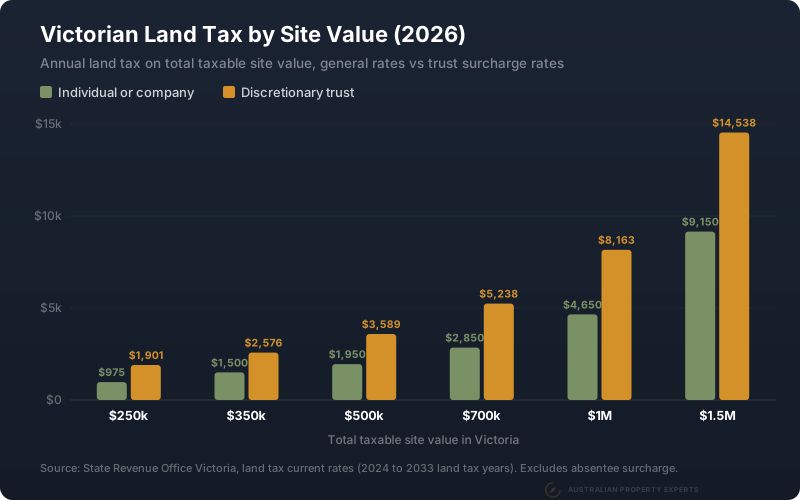
| Total taxable site value | Individual or company | Discretionary trust | Individual, per week |
|---|---|---|---|
| $250,000 | $975 | $1,901 | $18.75 |
| $350,000 | $1,500 | $2,576 | $28.85 |
| $500,000 | $1,950 | $3,589 | $37.50 |
| $700,000 | $2,850 | $5,238 | $54.81 |
| $1,000,000 | $4,650 | $8,163 | $89.42 |
| $1,500,000 | $9,150 | $14,538 | $175.96 |
Your assessment notice shows the site value used. For 2026 assessments, it came from the 1 January 2025 valuation. The 2027 assessments will use the 1 January 2026 general valuation.
Land tax on a second Victorian property
Everything you own in Victoria at midnight on 31 December is added together. Your home is left out. The rates then apply to the total. Because the rate rises with the total, two Victorian properties cost more together than they would on separate bills.
Take two investment properties with site values of $400,000 and $450,000. On their own they’d attract $1,650 and $1,800, so $3,450 in total. Combined, the $850,000 is assessed at $3,750. Holding both in Victoria costs an extra $300 a year because the values are combined.
Now buy the second one in Queensland instead, at the same $450,000 land value. It sits under Queensland’s $600,000 threshold for individuals. Your Victorian bill stays at $1,650.
Each state taxes only its own land. That’s one reason we buy for clients across the country. The land tax comparison by state sets out the thresholds. For a growing portfolio, how to reduce land tax across states works through the numbers.
Victoria’s land tax trust surcharge
Trusts pay a surcharge on top of the general rates, from a lower threshold of $25,000. It adds 0.375% across most of the scale, then phases out between $1.8 million and $3 million. On a $500,000 site value a discretionary trust pays $3,589, against $1,950 for an individual.
Some trusts can be assessed at general rates instead:
- Unit and fixed trusts: if the State Revenue Office has been told who the unitholders or beneficiaries are and their share of the land. Changes must be notified within one month.
- Complying superannuation funds: these are excluded trusts, but the trustee has to notify the State Revenue Office in writing.
- Discretionary trusts: the trustee can nominate one beneficiary who uses the land as their home, which doesn’t help with an investment property.
If you’re considering a trust for asset protection or tax reasons, weigh the land tax difference before you sign. Our guide to trust structures for property investment compares the options. Your accountant should confirm the right structure.
Absentee owner surcharge
An absentee owner is a foreign person who doesn’t ordinarily live in Australia. Australian citizens and permanent residents living overseas aren’t caught. Absentee owners have paid a 4% surcharge since the 2024 land tax year, on top of general land tax. It applies to the whole taxable value once that reaches $50,000, or $25,000 for trusts. On a $400,000 site value, that’s $16,000 of surcharge plus $1,650 of general land tax. Absentee owners must notify the State Revenue Office by 15 January.
Vacant residential land tax
Vacant residential land tax now covers residential land across the whole state. Before 2025 it only applied in 16 Melbourne council areas. A property counts as vacant if no one lived in it for more than six months of the previous year. The months don’t have to be continuous. Owners must notify the State Revenue Office by 15 February.
The tax is charged on the capital improved value, which is the land and the house together. There’s no threshold. It’s 1% in the first year a property is liable, 2% in the second consecutive year and 3% from the third. Leave a $600,000 property empty and the first year costs $6,000 on top of any land tax.
Holiday homes are taxed too. The State Revenue Office says a holiday home gets no land tax exemption, whether or not it earns income. It can escape vacant residential land tax if you or your relatives use it for at least four weeks in the calendar year. To qualify, your main home must also be in Australia.
Victorian land tax dates and payments
- Taxing date: midnight on 31 December. Whoever owns the land then pays for the following year, so 2027 land tax will be assessed on land held on 31 December 2026.
- Assessments: issued between January and June each year.
- Payment: due 12 weeks after the issue date. You can spread it over up to 38 weeks, fortnightly, monthly or in four instalments, with no interest if the plan is set up before the due date. Plans have to be set up again each year.
- Errors: tell the State Revenue Office within 60 days of the issue date if your assessment is wrong.
Land tax on an investment property is deductible. It comes off your rental income. For everything else you can claim, see our guide to investment property tax deductions.
Budgeting for land tax in Victoria
In Victoria, land tax is a holding cost from the first investment property, not the second or third. A $500,000 site value costs an individual $37.50 a week. In a trust it’s about $69.
Put that figure into your cash flow before you buy. Then weigh it against the yield and growth the property offers. If you’re comparing states, the NSW land tax guide and the Queensland land tax guide show how differently the other two big states treat the same property.
Sources
- State Revenue Office Victoria, land tax current rates for general and trust surcharge rates.
- State Revenue Office Victoria, COVID-19 debt repayment plan for the temporary measures in the 2024 to 2033 land tax years, and historical land tax rates.
- State Revenue Office Victoria, site values and land tax for the 1 January 2025 valuation used in 2026.
- State Revenue Office Victoria, trusts and land tax and absentee owner surcharge.
- State Revenue Office Victoria, vacant residential land tax and VRLT rates.
- State Revenue Office Victoria, paying your land tax.
- Valuer-General Victoria, revaluation 2026 outcomes.
- Land tax figures were calculated with our land tax calculator, using the 2026 rates above.
This is general information only and not financial or tax advice. Speak to a qualified professional before making investment decisions.
If you’re weighing up a Victorian purchase against other states, book a free discovery call.