In Queensland, you pay land tax as an individual once your land in the state is worth $600,000 or more. Your home isn’t counted. Companies and trusts start much earlier, at $350,000, on a steeper scale. So the biggest land tax decision a Queensland investor makes is whose name goes on the contract.
Many investors with one Queensland property in their own name pay no land tax at all. Below are the 2026-27 rates for individuals, companies and trusts. The latest Ipswich and Gold Coast figures show how land value averaging softens a revaluation.
QLD land tax rates for individuals
These are the rates in Schedule 1 of the Land Tax Act 2010. They apply for the 2026-27 year.
| Total taxable value | Land tax |
|---|---|
| Under $600,000 | Nil |
| $600,000 to under $1,000,000 | $500 plus 1% of the value above $600,000 |
| $1,000,000 to under $3,000,000 | $4,500 plus 1.65% of the value above $1,000,000 |
| $3,000,000 to under $5,000,000 | $37,500 plus 1.25% of the value above $3,000,000 |
| $5,000,000 to under $10,000,000 | $62,500 plus 1.75% of the value above $5,000,000 |
| $10,000,000 and over | $150,000 plus 2.25% of the value above $10,000,000 |
At a taxable value of $599,999 you pay nothing, but at $600,000 you pay $500.
The land tax calculator, set to Queensland, compares the bill for an individual, a company and each type of trust.
QLD land tax for companies and trusts
Companies and trustees, including those of self-managed super funds, use Schedule 2, with a threshold of $350,000.
| Total taxable value | Land tax |
|---|---|
| Under $350,000 | Nil |
| $350,000 to under $2,250,000 | $1,450 plus 1.7% of the value above $350,000 |
| $2,250,000 to under $5,000,000 | $33,750 plus 1.5% of the value above $2,250,000 |
| $5,000,000 to under $10,000,000 | $75,000 plus 2.25% of the value above $5,000,000 |
| $10,000,000 and over | $187,500 plus 2.75% of the value above $10,000,000 |
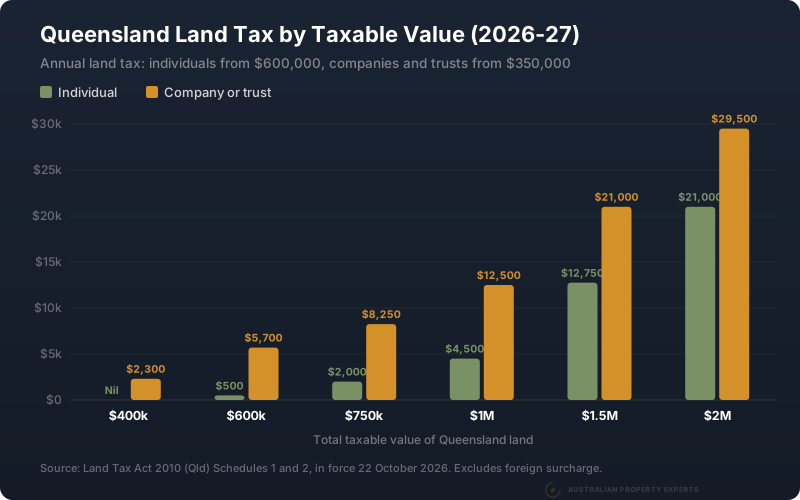
| Total taxable value | Individual | Company or trust |
|---|---|---|
| $500,000 | Nil | $4,000 |
| $650,000 | $1,000 | $6,550 |
| $800,000 | $2,500 | $9,100 |
| $1,000,000 | $4,500 | $12,500 |
| $1,500,000 | $12,750 | $21,000 |
On a $500,000 taxable value, an individual pays nothing while a company or trust pays $4,000 a year. The Queensland Revenue Office’s own worked example has a self-managed super fund with $760,000 of taxable land paying $8,420. In your own name it would be $2,100.
A trust or company can still suit you for asset protection. Weigh the land tax cost with your accountant before you sign. Our guide to trust structures for property investment goes through the trade-offs.
How Queensland values your land
Queensland land tax is set by the land you own at midnight on 30 June. So the 2026-27 assessment covers land held on 30 June 2026. The value used is the land only.
It isn’t always this year’s valuation. The Queensland Revenue Office uses whichever is lower: the current statutory land value, or the average of the values for this year and the two before. When values jump after a revaluation, the average comes in lower. The bill catches up over three years.
The Valuer-General issued new land valuations for 15 council areas on 11 March 2026. They take effect from 30 June 2026. Two of them were the Gold Coast and Ipswich.
- Gold Coast: the median residential land value is $720,000, up 18% since the 2024 valuation. On $720,000, an individual would pay $1,700. Averaged with the two years before, the taxable value is about $646,780. On that, the bill is about $968.
- Ipswich: the median residential land value is $430,000, up 54% since the 2023 valuation. That’s under the individual threshold either way. In a company or trust, $430,000 would attract $2,810. But the averaged value is about $329,481, under the $350,000 threshold. This year’s bill is nil.
Neither council was revalued in 2025, so the earlier valuation counts for two of the three years. The averaged figures assume the median block moved in line with the council-wide median. Your own notice shows the taxable value the Queensland Revenue Office used.
Brisbane, Logan, Toowoomba and Townsville were last revalued in 2025, with overall rises of 17.4%, 18.7%, 31.1% and 27.5%. Those rises are still working through the average. Without a new valuation, the averaged value there keeps rising each year until it reaches the 2025 value in 2027-28.
Interstate property and QLD land tax
The Land Tax Act defines taxable land as land in Queensland. A property you own in NSW, Victoria or anywhere else doesn’t add to your Queensland total. Nor does a Queensland property count towards another state’s total.
So two investment properties in two states can each sit under their own threshold. Put the same two in Queensland and they’re added together. A Gold Coast block at $720,000 plus an Ipswich block at $430,000 comes to $1,150,000, or about $976,261 after averaging. In your own name, that’s about $4,263 this year, against about $968 for the Gold Coast block on its own.
Queensland planned to count interstate land in 2022. The idea was dropped. Our post on reducing land tax across states covers what happened. The land tax comparison by state sets out each threshold.
QLD foreign and absentee surcharge
Foreign companies, trustees of foreign trusts and absentees pay a 3% surcharge on the taxable value above $350,000. It sits on top of land tax. The Queensland Revenue Office’s example is a foreign company with $400,000 of taxable land. It pays $2,300 of land tax and $1,500 of surcharge, so $3,800 in total. Absentees use their own scale. It matches the company scale up to $5 million and is slightly lower above it.
Your home and the moving-house exemption
Your home is exempt. It must be your only principal place of residence, used exclusively as your home.
When you move, the transitional home exemption can cover both properties for one year. You need to have become the owner of the new home in the 12 months before 30 June. You also need to have sold the old home by the following 30 June. A home still under construction at 30 June doesn’t qualify.
Sometimes a home stops being eligible. When that happens, tell the Queensland Revenue Office in writing by 31 July of that tax year.
Queensland land tax dates and payments
- Taxing date: midnight on 30 June.
- Notices: issued from August onwards. The 2026-27 notices started on 17 August 2026.
- Payment: by the due date on your notice, by BPAY, card, direct debit or transfer.
- Extended payment option: three equal, interest-free payments 45, 90 and 150 days after the notice is issued, by direct debit only. You need to register within 35 days of the notice.
- Errors and objections: report an error within 30 days, or lodge an objection within 60 days of the issue date.
You can claim land tax on an investment property as a deduction against the rent. Our guide to investment property tax deductions lists the other costs you can claim.
Ownership structure and QLD land tax
In Queensland, the threshold you get depends on whose name is on the title. A $500,000 block in your own name pays nothing. In a company or trust, the same block costs $4,000 a year from day one.
Decide that with your accountant before you sign. Then plan where the next property goes. The NSW land tax guide and the Victorian land tax guide set out the rates and example bills for those states.
Sources
- Land Tax Act 2010 (Qld), in force 22 October 2026, Schedules 1, 2 and 3, and sections 7 and 9.
- Queensland Revenue Office, rates for companies and trusts for the self-managed super fund example, and foreign companies and trusts for the surcharge example.
- Queensland Revenue Office, taxable value for averaging.
- Queensland Revenue Office, home exemption, transitional home exemption and notifying when you’re ineligible.
- Queensland Revenue Office, assessment notices and extended payment option.
- Queensland Government, 2026 land valuations for the Gold Coast and Ipswich medians, and valuation trends for the 2025 changes.
- Land tax figures were calculated with our land tax calculator, using the rates above.
This is general information only and not financial or tax advice. Speak to a qualified professional before making investment decisions.
If you’re deciding how to hold your next Queensland property, book a free discovery call.