Land tax in NSW starts once the land you own in the state, not counting your home, is worth more than $1,075,000. Above that you pay $100 plus 1.6% of the excess. The rate rises to 2% once you pass $6,571,000. Because both thresholds have been frozen since the 2025 land tax year, every rise in land values pulls more investors in.
With one NSW property, most investors pay nothing. The bill usually starts with the second or third purchase, or with a trust. This guide covers the 2026 rates and what median blocks in nine NSW councils pay. It also covers the dates that decide when you’re liable.
NSW land tax rates for 2026
| Total taxable land value | Land tax for 2026 |
|---|---|
| Up to $1,075,000 | Nil |
| $1,075,000 to $6,571,000 | $100 plus 1.6% of the value above $1,075,000 |
| Above $6,571,000 | $88,036 plus 2% of the value above $6,571,000 |
On land worth $1,655,000 in total, that works out to $9,380.
The thresholds no longer move with the market. The 2024-25 NSW Budget froze them for every land tax year after 2024. Revenue NSW says the Treasurer will assess them by 1 June 2027. Meanwhile the Valuer General found NSW residential land values rose 4.2% in the year to 1 July 2025. In Greater Sydney they rose 4.7%. A portfolio that sat under the threshold three years ago can be over it now without you buying anything.
To test your own numbers, open the land tax calculator set to NSW. It shows the bill for an individual, a company and each type of trust side by side.
How NSW works out your land value
NSW land tax is based on the land you own at midnight on 31 December. Revenue NSW calls this the taxing date. The 2026 land tax year was assessed on land held at the end of 2025.
The value is the land only, without the house on it. In the Blacktown council area, the Valuer General’s median sale price at 1 July 2025 was $1,170,000, against a median land value of $758,000.
Revenue NSW also smooths the number. It averages the Valuer General’s land values at 1 July over the last three years. In Penrith, the median land value rose 26.7% between 2023 and 2025, from $525,000 to $665,000. The average used for 2026 was only $594,667.
All your taxable NSW land is then added together. The threshold applies once, to the total, with your home excluded.
What a median block pays in land tax
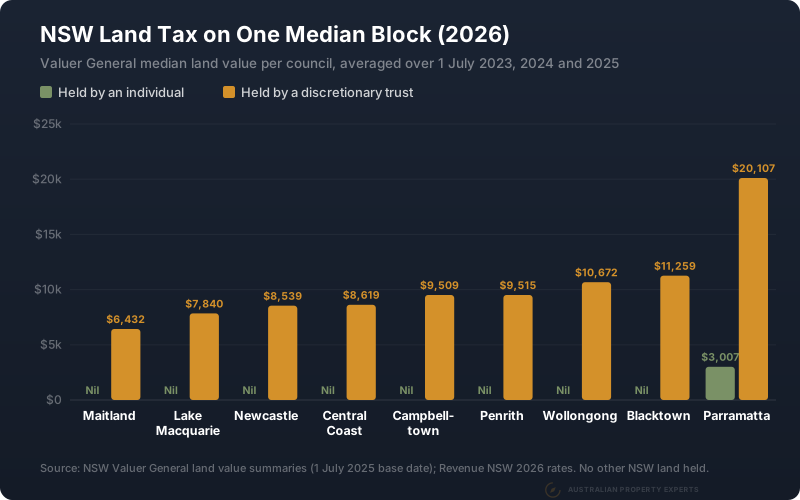
These are the Valuer General’s median land values for nine council areas. Each is averaged over 1 July 2023, 2024 and 2025, the way Revenue NSW does it. The table is sorted by that average.
| Council | Median land value, 1 July 2025 | Three-year average | Land tax as an individual |
|---|---|---|---|
| Maitland | $415,000 | $402,000 | Nil |
| Lake Macquarie | $504,000 | $490,000 | Nil |
| Newcastle | $565,000 | $533,667 | Nil |
| Central Coast | $567,000 | $538,667 | Nil |
| Campbelltown | $648,000 | $594,333 | Nil |
| Penrith | $665,000 | $594,667 | Nil |
| Wollongong | $660,000 | $667,000 | Nil |
| Blacktown | $758,000 | $703,667 | Nil |
| Parramatta | $1,330,000 | $1,256,667 | $3,007 |
On one median block, an individual pays nothing in eight of the nine councils. Parramatta is the exception, at $3,007 a year. Your own land value will differ from the median. Check the figure on your Valuer General notice before you rely on any of these.
Land tax on a second NSW property
Add a second property in the same state and the two land values are combined. These pairs use the averaged medians from the table above.
| Two properties held by one person | Combined land value | Land tax for 2026 |
|---|---|---|
| Newcastle and Central Coast | $1,072,334 | Nil |
| Campbelltown and Penrith | $1,189,000 | $1,924 |
| Blacktown and Penrith | $1,298,334 | $3,673 |
| Blacktown and Wollongong | $1,370,667 | $4,831 |
The Newcastle and Central Coast pair lands just $2,666 under the threshold. With the threshold frozen, a modest rise in land values in either council would push the pair over. Even the cheapest median blocks cross the threshold once you hold three. Three median Maitland blocks, at a combined $1,206,000, attract $2,196 a year.
A property in another state is assessed by that state, against its own threshold. It doesn’t add to your NSW total. It’s one of the reasons we buy in every state. The land tax comparison by state sets out how each threshold works. For the numbers on spreading a portfolio, see how to reduce land tax across states.
NSW land tax for trusts
Most family and discretionary trusts are special trusts in NSW. A special trust gets no threshold at all. Revenue NSW taxes it at a flat 1.6% from the first dollar up to the premium threshold, then 2%.
The median Blacktown block that pays nothing in your own name costs $11,259 a year in a discretionary trust. A median Maitland block costs $6,432. In Parramatta it’s $20,107.
A trust can get the threshold if it qualifies as a fixed trust. To qualify, the beneficiaries must be presently entitled to all the income. Their rights to income and capital must be fixed, with no discretion that can change them. A unit trust also needs a single class of units. If a deed is amended so the trust qualifies, the threshold only applies from the next land tax year.
There can still be good reasons to buy in a trust, such as asset protection or how income is distributed. Land tax belongs in that decision from the start. Talk to your accountant before you sign. Our guide to trust structures for property investment covers the trade-offs.
Surcharge land tax for foreign owners
Foreign persons pay surcharge land tax on top of general land tax. From the 2025 land tax year the rate is 5% of the land value, with no threshold. A $600,000 land value attracts $30,000 of surcharge before any general land tax.
Your home and the residence exemption
Your principal place of residence is exempt. From the 2026 land tax year, the people living in the home must together own at least 25% of it. Each family can claim only one exemption. It doesn’t apply to land owned by a company or held in a special trust.
Moving house has its own rule. Say you buy a new home between 1 July and 31 December 2026 while you still own the old one. You may be able to claim both for the 2027 land tax year. You need to move into the new home before 31 December 2027. You also need to have lived in the old home, without renting it out, from 1 July to 31 December 2026. Building or renovating a home has a separate concession of up to four years.
NSW land tax dates and payments
- Taxing date: midnight on 31 December. Whoever owns the land then is assessed for the following land tax year, so the 2027 assessment will be based on land held on 31 December 2026.
- Registering: if you become liable for the first time, Revenue NSW expects you to register by 31 March.
- Notices: Revenue NSW issued 2026 notices from 19 January 2026 and says 2027 notices will start in January 2027.
- Payment: due 60 days after the notice is issued. Paying in full by the due date earns a 0.5% discount. Interest-free plans run over 3, 6 or 9 months.
- Penalties: owners who don’t register can be back-assessed with interest and penalty tax.
Land tax on a rental is deductible. It reduces your taxable rental income. Our guide to investment property tax deductions covers the other costs you can claim.
Plan NSW land tax before you buy
Your bill depends on how much NSW land you end up holding. Once you’re over $1,075,000, it rises with land values for as long as the threshold stays frozen. Run the numbers before you exchange. Ask your accountant which structure suits the property.
Sources
- Revenue NSW, land tax thresholds and rates for the 2026 rates and the frozen thresholds, and Preparing for the 2025 land tax year for the 1 June 2027 review.
- Revenue NSW, how land tax is calculated for the taxing date and the three-year average.
- Revenue NSW, trusts for special and fixed trust rules.
- Revenue NSW, surcharge land tax for the 5% rate.
- Revenue NSW, principal place of residence exemption and interest-free payment plans, and land tax investigations.
- NSW Valuer General, land value summaries by council for median land values at 1 July 2023, 2024 and 2025, the 2025 NSW land valuations release and the 2025 Greater Sydney land values release.
- Land tax figures for each scenario were calculated with our land tax calculator, using the 2026 rates above.
This is general information only and not financial or tax advice. Speak to a qualified professional before making investment decisions.
If you’re working out where your next property should go and how to hold it, book a free discovery call.