Since 16 October, Victorian agents have had to publish the vendor’s reserve price before every home auction. The state’s new auction rules say it must go online at least 7 days out. It has to be one dollar figure, with no “from” or “+” in front of it.
The first five weeks of results are in. Victorian homes sold at auction went for a median of 0.9% above the published reserve. That figure comes from the property platform Homer, reported by the ABC.
What the new auction rules require
The rules come from the Consumer Legislation Amendment Act 2026. They started on 1 October, but auctions in the first two weeks were exempt. The first sales covered were on 16 October, with reserves online by 9 October.
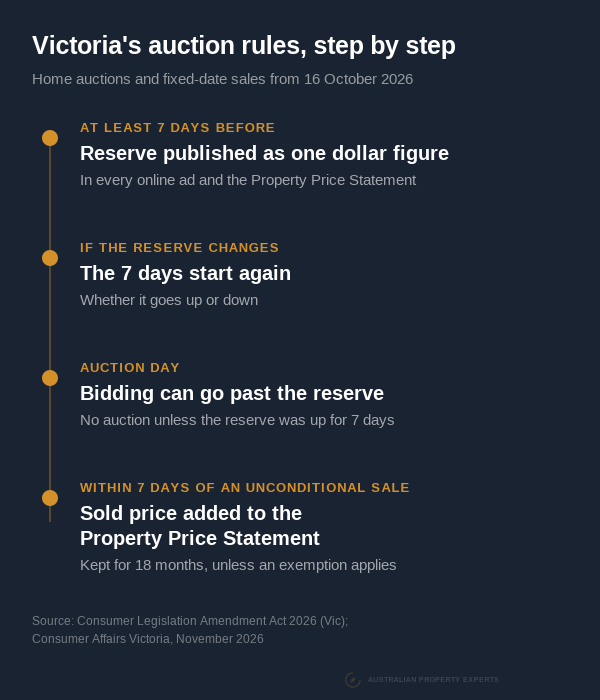
For the 7 days before the sale, the reserve has to appear prominently in every online ad. It also goes in the Property Price Statement, the document that replaced the Statement of Information.
If the reserve hasn’t been up for the full 7 days, the agent can’t run the auction. The maximum penalty for an agent is more than $50,000, according to Consumer Affairs Victoria.
The rules cover auctions and fixed-date sales. In a fixed-date sale, the vendor sets a date and time by which offers must be in. Consumer Affairs Victoria says boardroom auctions count too. Private sales without a closing date aren’t covered. Neither are off-market sales, or rural, commercial and industrial property.
When the reserve price changes
A vendor can still change the reserve. Any change, up or down, restarts the clock. So a vendor who drops their reserve on the Thursday before a Saturday auction has to push the auction back.
Publishing the reserve doesn’t lock the vendor in. They can still accept a bid below it on the day, according to Consumer Affairs Victoria. Bidding can also run well past it.
Pre-auction offers count as a private sale. A vendor can accept one and cancel the auction without waiting out the 7 days. If the vendor knocks back a written offer as too low, the agent has to update the price guide. The reserve can stay where it is.
What the Property Price Statement shows
The Property Price Statement still carries the indicative selling price, which is the agent’s price guide. It can be one figure or a range no wider than 10%. The statement also lists the three most comparable sales, or fewer if three can’t be found. It shows the suburb median too, plus the reserve for auctions and fixed-date sales. Online it has to sit next to the advertised price, not at the bottom of the listing.
In metropolitan Melbourne, those comparable sales must be from the last 6 months and within 2 km. Elsewhere it’s 18 months and 5 km.
No ad can show a price below the reserve once the agent has it. If the reserve is above the guide, the guide has to come up to match.
Within 7 days of an unconditional sale, the agent generally has to add the sale price to the Property Price Statement. It stays up for at least 18 months, private sales included. There are exemptions, including for family violence and some agency agreements signed before October. By 1 December 2027, agents will also report sold prices to Consumer Affairs Victoria.
Melbourne auctions since 16 October
Auction numbers fell straight away. Melbourne held 500 auctions in the first week. That was down from 703 the week before and 1,142 a year earlier. Cotality said the drop coincided with the rules. In the week to 15 November, Melbourne’s 688 auctions were still 52.6% below the same week last year.
The rules aren’t the only reason. As the ABC pointed out, the market was cooling anyway. The cash rate has gone up five times this year, most recently to 4.85% in November.
Homer tracked 2,164 Victorian residential auctions from 16 October to 14 November. Sold homes went for a median of 0.9% above the published reserve. More than three quarters of the homes that sold had a reserve inside the guide.
It’s a small sample. Property economist Cameron Kusher told the ABC it’s hard to read much into five weeks of data in a down market. Before the law passed, RMIT’s Peyman Khezr warned that homes would still sell 10, 20 or 30 per cent above the advertised figure.
How to use a published reserve
The reserve is the price the vendor has said they’ll sell at. What the property is worth still has to come from recent comparable sales. The three in the Property Price Statement are a start, but the agent chose them. Before we bid for a client, we pick our own comparable sales and value the property from those. Our bidding limit comes from that figure, whatever the reserve is.
A published reserve tells you a week out whether the vendor wants more than the property is worth. If they do, you can walk away before you pay for a building and pest report, which typically runs $400 to $800. You also save on a contract review. You don’t get those costs back if you miss out, as we covered in auction vs private treaty.
Watch for a guide that jumps when the reserve is published. It means the vendor wants more than the agent first estimated. Nothing stops you offering below the published reserve before the auction, because a pre-auction offer is a private sale. With the reserve public, you can see how far apart you are before you make an offer.
If you’re buying interstate, knowing the reserve a week ahead saves wasted effort. Under the old rules, a Sydney investor could line up finance and inspections for a Melbourne auction. They’d find out on the day that the vendor wanted well above the guide.
What this means for buying in Victoria
A buyer at a Victorian auction now walks in knowing the reserve. Sold prices will generally be online within a week of each sale, so the comparable sales you check next time will be better too.
Victoria is also earlier in its cycle than Queensland, WA or SA. It’s where we see more upside over the next few years. Our Melbourne market post covers prices and yields. Our Melbourne buyers agent page explains where we buy for clients.
NSW was meant to bring in its own price guide rules on 17 November, but has paused them until December 2027. We’ve covered what that means separately.
This is general information only and not financial advice. Speak to a qualified professional before making investment decisions.
If you’re looking at investment property in Melbourne or regional Victoria, book a free discovery call.