The RBA lifted the cash rate to 4.85% on Tuesday 3 November 2026. It’s the fifth rise this year, and the cash rate is now at its highest since 2008. The vote was split. Six of the nine Board members voted for the rise and three wanted to hold at 4.60% (RBA).
Over a 10 to 15 year hold, rates will rise and fall more than once. This one adds about $1,250 a year to the interest on a $500,000 loan. It comes while capital city values are falling at the fastest pace Cotality has recorded in 40 years. Below is what the rise adds to repayments, what it does to borrowing power and where prices now sit.
Why the RBA Raised Rates Again
Inflation came in higher than expected. The ABS reported annual inflation of 4.3% in the 12 months to September 2026, up from 4.0% in August. Prices rose 1.3% over the September quarter. The trimmed mean, the measure the RBA watches most closely, rose to 3.6% over the year (ABS).
Housing costs were the biggest contributor, up 5.2% over the year. In the CPI, housing means rents, the cost of building new homes and utilities. It doesn’t include the price of existing homes. Electricity rose 12.8% and transport 8.7%. New dwelling prices were up 4.7% as builders passed on higher costs.
The Board’s statement says inflation “is now expected to remain above 3 per cent for the coming year”. It also warns of a growing risk that businesses and workers start expecting higher inflation and set prices and wages to match. The RBA doesn’t expect inflation back at the top of its 2 to 3% target range until late 2027. That’s about nine months later than it forecast in August.
The September quarter figures came out on 28 October, a month after the RBA’s September rise. Straight after the release, markets saw about an 85% chance of a November rise. Of the 32 economists Reuters polled before the meeting, 30 expected one.
Here is how the cash rate has moved this year:
| Decision | Change | Cash rate |
|---|---|---|
| 3 February | +0.25 | 3.85% |
| 17 March | +0.25 | 4.10% |
| 5 May | +0.25 | 4.35% |
| 16 June | Hold | 4.35% |
| 11 August | Hold | 4.35% |
| 29 September | +0.25 | 4.60% |
| 3 November | +0.25 | 4.85% |
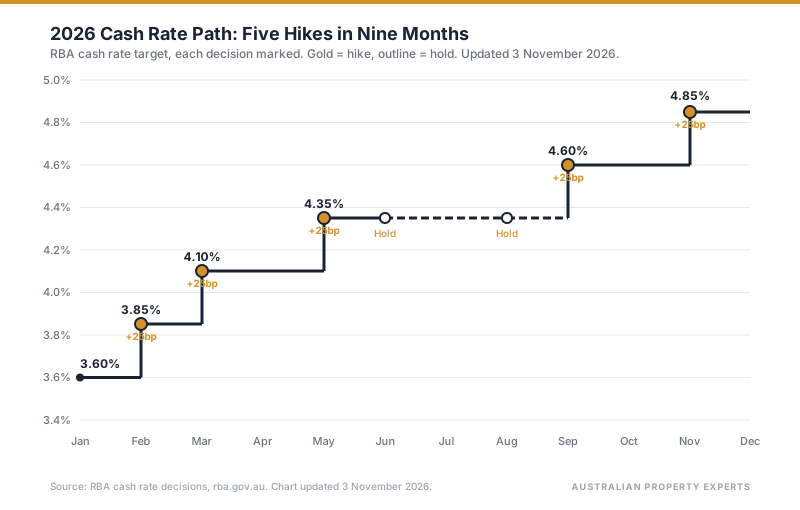
The three 2025 cuts are now undone. The cash rate is 0.50 points higher than it was before the first of them in February 2025. Our post on the earlier 2026 rises covers how the year started.
What 4.85% Adds to Repayments
Each 0.25 point rise adds about $104 a month to the interest on a $500,000 interest-only loan. Across the five rises this year, the same loan costs about $521 a month more than in January, or $6,250 a year. The table shows the extra interest since January on interest-only loans of other sizes.
| Loan size | Extra per month | Extra per year |
|---|---|---|
| $400,000 | $417 | $5,000 |
| $500,000 | $521 | $6,250 |
| $600,000 | $625 | $7,500 |
| $700,000 | $729 | $8,750 |
NAB will lift its variable home loan rates by 0.25% from Friday 13 November 2026 (NAB). The other major banks are passing on the same rise from the same date.
On a $500,000 loan, you’d need about $120 a week more rent than in January just to cover the extra interest. Rents are still rising, but more slowly. Cotality’s national rent index rose 0.9% over the three months to October, the smallest rise since January 2025.
Borrowing Power After Five Rises
Borrowing power has fallen further than prices. Before the decision, Cotality’s research director, Tim Lawless, said one more rise would mean “borrowing capacity has dropped by around 11.5%, or more than $105,000 through the rate-hiking cycle to date.” That rise has now happened. A $105,000 drop in borrowing power is more than the $63,400 the national median value has fallen since March.
Lenders test new loans at the actual rate plus APRA’s 3 percentage point buffer. With new investor rates now close to 7%, that puts the assessment rate near 10%. APRA also caps high-debt lending. Since 1 February 2026, no more than 20% of a lender’s new investor loans can go to borrowers whose total debt is six or more times their income. Loans to buy or build a new home are exempt.
If the bank says you can’t borrow any more, our serviceability wall post covers what still helps. If you own your home, you can still draw on its equity, but expect the bank’s valuation to come in lower while prices are falling. Our home equity guide shows how to work out what’s usable.
Where Property Prices Stand
National home values fell 1.2% in October, the seventh fall in a row. They now sit 6.7% below their March peak (Cotality). The combined capitals have fallen 8.1% in seven months.
| City | October | Over 3 months | From peak | Median |
|---|---|---|---|---|
| Sydney | -1.6% | -4.7% | -10.1% | $1,178,959 |
| Melbourne | -0.8% | -2.7% | -8.2% | $773,027 |
| Brisbane | -2.0% | -6.1% | -8.3% | $1,018,401 |
| Adelaide | -1.2% | -3.9% | -4.4% | $916,860 |
| Perth | -1.7% | -5.7% | -8.9% | $942,018 |
| Hobart | +0.5% | -0.3% | -1.5% | $743,854 |
| Darwin | +0.6% | -0.2% | -0.2% | $641,873 |
| Canberra | -0.7% | -3.1% | -6.9% | $844,400 |
The medians cover all dwellings, houses and units together. Melbourne and Hobart are measured from their March 2022 peaks, Canberra from May 2022 and the other capitals from their 2026 peaks.
Selling conditions have swung towards buyers. Homes are taking a median 39 days to sell, the longest since August 2020. Vendors are knocking an average 4.7% off to get a sale, the most since May 2019. Capital city listings are at their highest for this time of year since 2019. Fewer than half of auctions are clearing.
With rents up and values down, gross yields across the combined capitals have reached 3.77%, the highest since May 2015. Cotality says that still isn’t enough for most investors to break even, with investor rates close to 7% and insurance, strata and maintenance costs all up.
CBA’s economists now expect national values to fall about 14% from peak to trough, and about 18% in Brisbane and Perth (CommBank). If you’re buying in either city, that’s the fall to plan your loan and cash buffer around.
RBA Rate Forecasts for 2027
No major bank expects a cut soon. Westpac thinks 4.85% is likely the peak of this cycle (Westpac). NAB isn’t forecasting further rises (NAB). CBA expects cuts in August and November 2027, taking the cash rate back to 4.35%. It also says the timing is uncertain, and that the bigger risk is rates needing to rise again in 2027 (CommBank).
The next RBA decision is on Tuesday 8 December 2026. After that, the Board meets on 9 February 2027.
What 4.85% Means for Buying Now
You’re paying more interest, but you’re buying in a market with more listings and bigger vendor discounts. Sales over the past three months were 23% lower than a year earlier, so fewer buyers are competing for each property.
Waiting for prices to bottom out has cost investors before. After the 2020 scare, national values fell 2.1% and then rose 22.4% in the year to January 2022. Our post on whether to buy now or wait looks at what happened to investors who waited through earlier downturns.
The risk is buying something you can’t hold if values fall further. Rates could also rise again. Three things to do before you buy:
- Refresh your pre-approval. Your borrowing power has fallen with every rise this year. Know the new number before you search.
- Stress-test your cash flow at today’s rate plus another 0.25 points. Keep cash aside to cover the weekly gap between rent and costs.
- Check the 2027 negative gearing change. If you exchange on an established home after 7:30pm AEST on 12 May 2026, from 1 July 2027 any rental loss on it can’t come off your salary. It can only be used against residential rental income or residential capital gains. The 2027 playbook explains how it works. Your accountant should check your own position.
This is general information only and not financial advice. Speak to a qualified professional before making investment decisions.
If you want to know what the numbers look like for you at 4.85%, book a free discovery call.
Sources
- RBA Monetary Policy Decision, 3 November 2026
- ABS: CPI rose 4.3% in the year to September 2026 and Consumer Price Index, September 2026
- Cotality Home Value Index, November 2026
- NAB: response to the RBA announcement
- CommBank economists: November RBA analysis and house price forecasts
- Westpac IQ: RBA decision, 3 November 2026
- NAB RBA Watch, 3 November 2026
- RBA Monetary Policy Board meeting schedule