South Australia taxes land held at general rates once its total site value is over $936,000 for 2026-27. An exempt home isn’t counted. That threshold moves with land values each year. For an individual it is the second highest in the country, behind NSW.
Land a discretionary trust has bought since 16 October 2019 is different. RevenueSA taxes it above $25,000. So in SA the biggest land tax decision is the same one Queensland investors face, whose name goes on the title.
This guide covers the 2026-27 rates, the trust rules, how joint owners are assessed and when the bill arrives.
SA land tax rates for 2026-27
These general rates apply to land you own in your own name, jointly with other people, or in a company. They also apply to some trusts.
| Total taxable site value | Land tax for 2026-27 |
|---|---|
| Up to $936,000 | Nil |
| $936,000 to $1,504,000 | 50 cents per $100 above $936,000 |
| $1,504,000 to $2,188,000 | $2,840 plus $1.00 per $100 above $1,504,000 |
| $2,188,000 to $3,504,000 | $9,680 plus $2.00 per $100 above $2,188,000 |
| Over $3,504,000 | $36,000 plus $2.40 per $100 above $3,504,000 |
RevenueSA charges each rate per $100 or part of $100. If the tax works out under $20, no assessment is issued.
Trust rates start much lower.
| Total taxable site value | Land tax at trust rates |
|---|---|
| Up to $25,000 | Nil |
| $25,000 to $936,000 | $125 plus 50 cents per $100 above $25,000 |
| $936,000 to $1,504,000 | $4,680 plus $1.00 per $100 above $936,000 |
| $1,504,000 to $2,188,000 | $10,360 plus $1.50 per $100 above $1,504,000 |
| $2,188,000 to $3,504,000 | $20,620 plus $2.40 per $100 above $2,188,000 |
| Over $3,504,000 | $52,204 plus $2.40 per $100 above $3,504,000 |
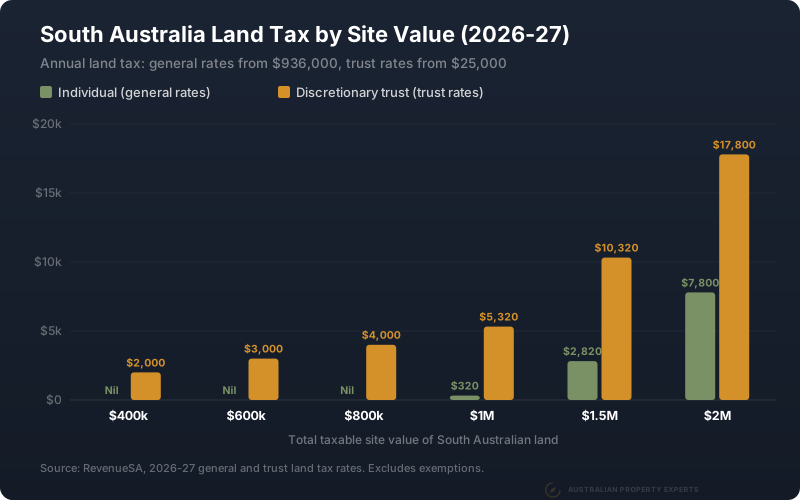
| Total taxable site value | General rates | Trust rates |
|---|---|---|
| $600,000 | Nil | $3,000 |
| $800,000 | Nil | $4,000 |
| $1,000,000 | $320 | $5,320 |
| $1,500,000 | $2,820 | $10,320 |
| $2,000,000 | $7,800 | $17,800 |
At $800,000 of site value, an individual pays nothing. The same land in a discretionary trust costs $4,000 a year. The gap is $5,000 at $1 million.
The land tax calculator, set to South Australia, shows the bill for each type of owner.
How the SA threshold is indexed
South Australia indexes its thresholds to land values. Each year the Valuer-General works out the average change in site values across the state. RevenueSA moves the thresholds by that change and gazettes them by 30 June.
For 2026-27 site values rose 12.44% on average. The general threshold went from $833,000 to $936,000. If average site values fall, the thresholds stay where they are.
| Year | General threshold |
|---|---|
| 2021-22 | $482,000 |
| 2022-23 | $534,000 |
| 2023-24 | $668,000 |
| 2024-25 | $732,000 |
| 2025-26 | $833,000 |
| 2026-27 | $936,000 |
The threshold has almost doubled in five years. That matters if you’re holding for the long term. A portfolio that grows in line with the state average keeps roughly the same room under the threshold. In NSW the threshold is frozen, so rising values push more land over it. The NSW land tax guide shows how that freeze plays out.
The trust threshold has stayed at $25,000 in every one of those years.
SA land tax for trusts
Whether a trust pays general rates or trust rates depends on the type of trust and what RevenueSA has been told.
All land a discretionary trust bought after midnight on 16 October 2019 pays trust rates. RevenueSA says there’s no exception. For land bought on or before that date, a trust could name a designated beneficiary to get general rates. Nominations closed on 31 December 2021.
Fixed trusts and unit trusts can pay general rates once the trustee has told RevenueSA who all the beneficiaries or unitholders are. Without that notice, they pay trust rates.
The trustee must tell RevenueSA within one month of the trust buying land. Late notice can bring interest and penalty tax.
Once RevenueSA has been told, each trust is assessed on its own. Land the trust holds isn’t added to land the trustee owns personally. Two trusts with the same trustee are assessed separately too. RevenueSA’s example is a discretionary trust with two properties bought after 16 October 2019, with site values of $750,000 and $800,000. Together that’s $1,550,000. The trust pays $11,050 a year.
The same $1,550,000 at general rates costs $3,300. Before you buy in a trust, ask your accountant whether the trust’s other benefits outweigh that difference.
Joint owners and companies
RevenueSA assesses each ownership separately. Land you own alone is one ownership. Land you own with your partner is another.
If you also own land in your own name, jointly owned land is assessed twice. First, the joint ownership gets its own assessment if its total is over the threshold. Then your share of that land is added to anything you own in your own name. If land tax was assessed in the joint ownership, you can get a deduction for your share of it. The same land isn’t taxed twice.
Your share depends on how the title is held. Tenants in common are assessed on the share shown on the title. Joint tenants are each taken to hold an equal share.
Related companies are grouped and assessed together as one ownership. One member of the group receives the assessment.
Your home and moving house
Your home can be exempt if you live in it permanently as your principal place of residence and it meets RevenueSA’s other conditions. If you own it jointly, usually only one owner needs to live there.
Moving can leave you holding two homes at midnight on 30 June. Only the one you live in on that date gets the exemption. The other can get a waiver for that year.
For the waiver, the old home has to be sold within the financial year. It can’t be rented between moving out and the sale. If you’re still in the old home on 30 June, the new home also can’t be rented at any time that year.
SA land tax dates and payments
- Taxing date: midnight on 30 June. RevenueSA counts the land you own then.
- Site values: set each year by the Valuer-General. You can object to a value within 60 days of receiving the first assessment notice.
- Payment: in full by the first due date, or in four quarterly instalments. The first instalment can include amounts owing from earlier years.
- How to pay: BPAY, Visa or Mastercard, or in person at Service SA and Australia Post.
You can claim land tax on an investment property as a deduction against the rent. Our guide to investment property tax deductions covers the rest.
Interstate land and foreign owners
South Australian land tax only counts land in South Australia. A property you own in Queensland or Victoria doesn’t add to your SA total. That’s why spreading a portfolio across states can keep each holding under its local threshold. Our post on reducing land tax across states works through an example.
SA doesn’t charge foreign owners a land tax surcharge. WA Treasury’s interstate comparison lists a 7% stamp duty surcharge for foreign buyers in SA instead.
Planning an Adelaide purchase around SA land tax
For an individual, the 2026-27 threshold is $936,000 and it moves with land values. Trusts are where it gets expensive. A discretionary trust buying now pays above $25,000.
Settle the ownership question with your accountant before you sign. We work through it with clients buying in Adelaide, alongside the suburb choice. The land tax comparison by state sets out every state’s threshold.
Sources
- RevenueSA, land tax rates and thresholds for the 2026-27 general and trust rates, past thresholds and the 12.44% average change in site values.
- RevenueSA, land held on trust for the trust rules and the $1,550,000 example.
- RevenueSA, how land tax is assessed for ownerships, joint owners and the taxing date, and corporate groups.
- RevenueSA, principal place of residence exemption and paying land tax.
- Department of Treasury and Finance WA, Overview of State Taxes and Royalties 2025-26 for the interstate comparison of land tax surcharges and foreign transfer duty surcharges.
- Land tax figures were calculated with our land tax calculator, using the rates above.
This is general information only and not financial or tax advice. Speak to a qualified professional before making investment decisions.
If you’re deciding how to hold your next South Australian property, book a free discovery call.