Positive gearing means the rent from an investment property is more than its deductible expenses, interest included. The ATO describes it as making a profit from renting the property out. That profit is added to your taxable income.
It’s harder to get there at 2026 interest rates than it was five years ago. From 1 July 2027 it also matters more, because losses on an established property bought now stop reducing the tax on your salary. The ATO’s latest figures show how many investors manage it. Cotality’s yields show which markets make it possible.
Positive vs negative gearing
Every investment property sits somewhere on the same line.
- Positively geared: rent is higher than your deductible expenses. You make a taxable profit.
- Neutrally geared: rent and expenses roughly cancel out.
- Negatively geared: expenses are higher than the rent. Whether the loss reduces the tax on your salary depends on when you bought.
The expenses that count include loan interest, council rates, insurance, land tax, property management, repairs and depreciation. Depreciation matters here because it is a deduction you don’t pay for in cash each year. A property can put money in your pocket every week and still show a small tax loss once depreciation is claimed.
Our negative gearing calculator shows the after-tax cost of a property and the point at which it turns positively geared.
How many investors are positively geared
The ATO’s 2023-24 taxation statistics, the latest published, count 2,335,540 individuals with an interest in a rental property. Of those, 1,266,454 reported a net rental loss and 1,069,086 were neutral or in profit. That is 45.8% at break-even or better.
The share rises with the size of the portfolio.
| Rental properties held | Neutral or in profit |
|---|---|
| 1 | 45.3% |
| 2 | 45.6% |
| 3 | 48.0% |
| 4 | 51.3% |
| 5 | 52.3% |
| 6 or more | 55.1% |
From four properties up, more than half of owners are neutral or in profit. The ATO doesn’t give a reason. A likely one is that bigger portfolios include properties bought years ago at lower prices. The rent on those has kept rising while the loan hasn’t.
Rental yields vs interest rates in 2026
Rent has to cover the interest before anything else. In September 2026, the RBA’s average rate on outstanding interest-only investor loans was 6.56%. On an interest-only loan for 80% of the purchase price, the interest alone comes to 5.25% of the price each year. Those figures predate the RBA’s 3 November rise in the cash rate to 4.85%. Rates move up and down over a 10 to 15 year hold. Rents tend to grow, while an interest-only loan balance stays where it started.
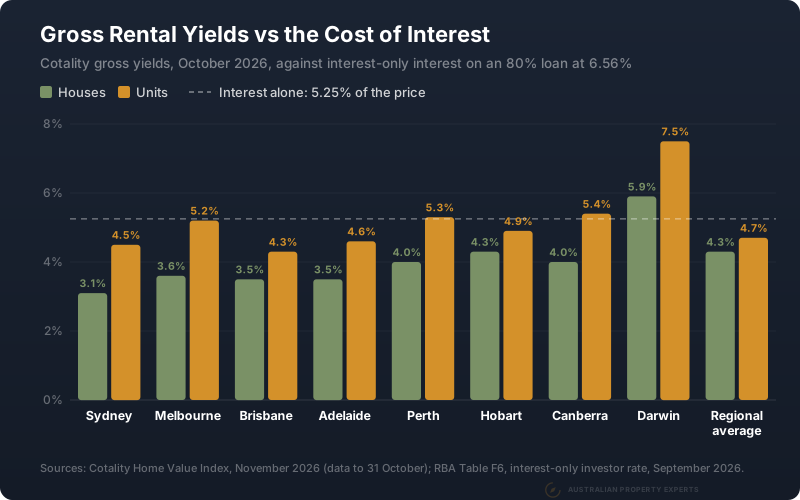
On Cotality’s October 2026 averages, few markets clear 5.25%.
| Market | Houses | Units |
|---|---|---|
| Sydney | 3.1% | 4.5% |
| Melbourne | 3.6% | 5.2% |
| Brisbane | 3.5% | 4.3% |
| Adelaide | 3.5% | 4.6% |
| Perth | 4.0% | 5.3% |
| Hobart | 4.3% | 4.9% |
| Canberra | 4.0% | 5.4% |
| Darwin | 5.9% | 7.5% |
| Regional average | 4.3% | 4.7% |
Darwin houses and units clear it, along with units in Perth and Canberra. Melbourne units fall just short at 5.2%. Outside the capitals, dwellings in regional WA yield 5.3% while houses in regional NT yield 7.8%. Cotality’s Tim Lawless said yields “are still nowhere near the levels needed to deliver a neutral or positive cash flow”. He added that insurance, strata, taxes and maintenance have all risen. Units show higher yields on paper. In our experience, houses on decent blocks deliver more of the growth, because the land is what appreciates.
Individual suburbs and properties sit well above and below these city-wide averages. Our post on what an investment property costs per week works through the weekly gap on a median home in every capital, including the other holding costs.
How to make a property positively geared
Most investors combine several of these.
Put more in. At a 60% loan, the interest-only cost at 6.56% falls to 3.94% of the price, against 5.25% at 80%. The trade-off is less money left for the next deposit.
Buy where the yield is. Higher-yield markets are usually more affordable ones. The yield has to come with growth, though. A town with a 7% yield and flat prices for a decade has paid its owner rent and nothing else. Our post on capital growth vs rental yield covers how to weigh the two.
Add a second income. A granny flat or a dual income property earns two rents from one block of land. The granny flat cash flow guide and the dual income property guide show the numbers.
Lift the rent. A cosmetic renovation, such as paint, flooring and an updated kitchen or bathroom, can lift the rent as well as the value. See cosmetic renovations for investment property.
Look at interest-only repayments. Interest-only repayments improve weekly cash flow because you aren’t paying down principal. They don’t change whether the property is positively geared for tax, because principal repayments were never deductible. See interest-only vs principal and interest loans for when each suits.
Positive gearing after the 2027 changes
The negative gearing changes are now law. The Treasury Laws Amendment (Tax Reform No. 1) Act 2026 received Royal Assent on 26 June 2026.
The Budget announced the changes at 7:30pm AEST on 12 May 2026. Properties held before then, including those under contract but not yet settled, keep negative gearing until they’re sold. Established properties bought after that can be negatively geared until 30 June 2027. From 1 July 2027, their losses can only be deducted against income from residential property, including capital gains. Any excess is carried forward. New builds are unaffected.
If you buy an established property now and it runs at a loss, that loss stops reducing the tax on your salary after 30 June 2027. You lose that yearly refund. The loss waits to be offset against future residential income or gains. A positively geared property loses nothing under the negative gearing changes, because it has no loss to carry forward. The CGT changes still apply when you sell. Our breakdown of the negative gearing and CGT changes from 2027 explains both in full, including the carry-forward rules. Speak to your accountant about how they apply to your own purchases.
Positive gearing as part of a portfolio
A positively geared property adds to your income. Lenders count most of the rent as income, which helps your borrowing capacity. Running out of borrowing capacity is usually what stops investors at the second or third property. For where positive gearing fits in a wider plan, see our guide to property investment strategies.
Positive gearing isn’t a goal on its own. Growth builds the equity that funds the next deposit, while yield keeps the properties affordable to hold in the meantime. The right balance between them shifts as the portfolio grows. We look for high-yield properties in affordable markets with room to grow.
Sources
- ATO, how to claim rental expenses for the definitions of positive and negative gearing.
- ATO, individuals statistics, Taxation Statistics 2023-24, Table 8, for rental property owners by net rent outcome.
- Cotality Home Value Index, November 2026, with data to 31 October 2026, for gross rental yields and the Tim Lawless quote.
- RBA, interest rate statistics, Table F6, for the September 2026 average interest-only investor loan rate, and the RBA’s 3 November 2026 decision.
- Budget 2026-27 tax explainer: negative gearing and capital gains tax and the Treasury Laws Amendment (Tax Reform No. 1) Act 2026.
This is general information only and not financial or tax advice. Speak to a qualified professional before making investment decisions.
If you’re working out how to balance growth and cash flow in your next purchase, book a free discovery call.