Labor is out in Victoria after 12 years. Jess Wilson’s Coalition won Saturday’s election in a landslide, and two of its promises matter for property investors. One cuts land tax for smaller portfolios. The other scraps stamp duty for first home buyers up to $1 million.
If your Victorian land in your own name totals under $300,000 in site value, you’d save up to $975 a year by 2031. Above that, the plan as costed doesn’t change your bill. Neither promise is law yet. The Parliamentary Budget Office costed both two days before the vote, with a start date for each step.
Who Won the Victorian Election
The ABC called it on Saturday night. By early Sunday the Coalition had 50 of the 88 lower house seats, with 45 needed for a majority. Some seats are still being counted. Premier Ben Carroll conceded on the night.
The upper house will take longer. Early counts had the Coalition and One Nation a few seats short of a majority there. Analyst Adrian Beaumont expects them to make it. One Nation is likely to back the land tax change. Its Victorian leader, Warren Pickering, said in September his party wanted the threshold back at $300,000.
Victorian Land Tax Changes
Victoria charges land tax once your investment land in the state adds up to $50,000 in site value. No other state starts that low. Site value is the land without the house, so it’s usually well under what you paid. The threshold was $300,000 until the COVID debt measures came in for the 2024 land tax year.
The Coalition’s plan takes it to $100,000 from 1 July 2027. It then goes up $50,000 a year until it’s back at $300,000 in July 2031. Trusts get the same lift. The PBO puts the cost at $401.5 million over the first four years.
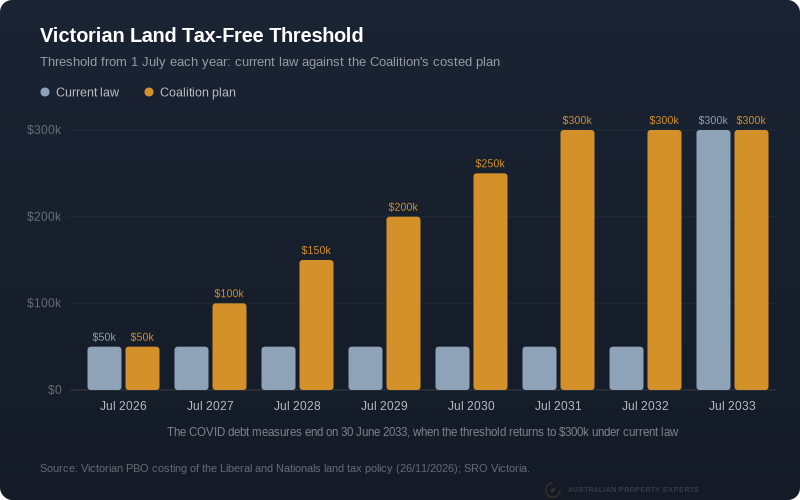
The $300,000 threshold is already due to return when the COVID debt measures end on 30 June 2033. Under current law it stays at $50,000 until then. The Coalition’s plan gets to $300,000 two years sooner, and the first step to $100,000 comes six years sooner.
Land tax is assessed on what you own at midnight on 31 December. If the first step starts in July 2027, I’d expect the first smaller bills to be the 2028 assessments.
Who Saves on Land Tax
If the land is in your name, the most you’d save is $975 a year. Today you pay $500 once your Victorian land reaches $50,000, rising to $975 at $100,000. Under $100,000, you’d stop paying it from the first step in July 2027. Under $300,000, it would be gone by July 2031. For an investor with one property in regional Victoria, that’s often the whole bill.
Above $300,000 in total, the plan as costed doesn’t change your bill, because it only moves the threshold. The COVID debt surcharge on bigger holdings runs until 2033 either way.
Trusts pay land tax on a separate scale. If you buy through a trust, ask your accountant what the change means for you. Our Victorian land tax guide shows the bill at each site value.
The $1M First Home Buyer Exemption
First home buyers in Victoria pay no stamp duty up to $600,000 today, with a concession up to $750,000. Above $750,000 they pay full duty. The Coalition’s costed plan lifts the exemption to $700,000 in 2027-28, then $100,000 a year to $1 million in 2030-31. Part of the cost comes from scrapping the $10,000 First Home Owner Grant. It’s only paid on new homes. A first home buyer of a new home under $600,000 already pays no duty, so they’d lose the $10,000 and gain nothing.
At the State Revenue Office’s current rates, full duty is $43,070 on an $800,000 home and $55,000 on $1 million.
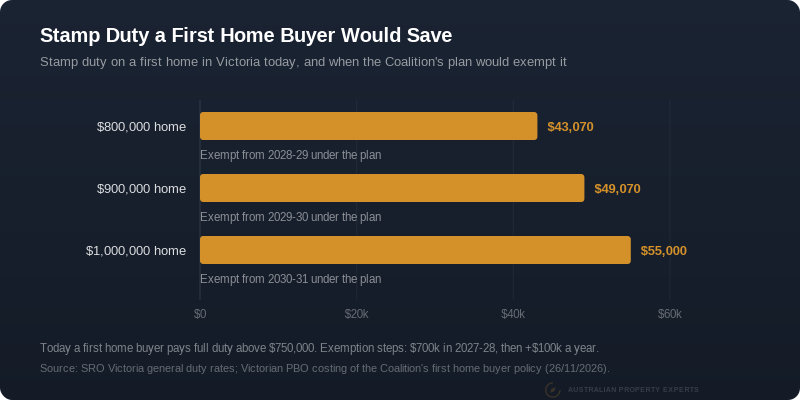
Investors still pay the general rates, but the exemption changes who you’re bidding against. I firmly believe this will supercharge demand at the lower end of the market. The $600,000 to $1 million range gets the biggest lift, and that’s where the typical regional Victorian house sits. From 2028-29, a first home buyer of an $800,000 home no longer needs $43,070 for duty. They can put it into their offer. They’re also the buyers you’ll sell to one day.
Other Coalition Property Policies
| Policy | Now | Under the Coalition's plan |
|---|---|---|
| Land tax-free threshold | $50,000 | $100,000 from 1 July 2027, $300,000 by 1 July 2031 |
| Land tax on land above $300,000 | General rates plus the COVID debt surcharge to 2033 | No change costed |
| First home buyer stamp duty | Nil to $600,000 | Nil to $1 million from 2030-31 |
| Stamp duty for investors | General rates | No change to general rates |
| Short-stay levy | 7.5% of the booking fee | 5% in 2028-29, 2.5% in 2029-30, nil from 2030-31 |
| Emergency services levy | Emergency Services and Volunteers Fund | Back to the Fire Services Property Levy from 1 July 2027 |
| Reserve price published 7 days before auction | In force since 16 October 2026 | Not in the costed platform |
| Rental energy standards | Phase in from 1 March 2027 | Not in the costed platform |
The PBO costing doesn’t say what the Fire Services Property Levy would charge investment properties, so we can’t tell you yet. Nothing in the platform changes the reserve price rule for auctions. Our guide to Victoria’s reserve price rules covers how to use it.
Melbourne Is Still Below Its 2022 Peak
Melbourne’s median dwelling value was $773,027 at the end of October on Cotality’s Home Value Index. That’s 8.2% below the March 2022 peak and 7.3% lower than five years ago. Over the same five years, Perth rose 68.3%, Adelaide 54.2% and Brisbane 46.1%.
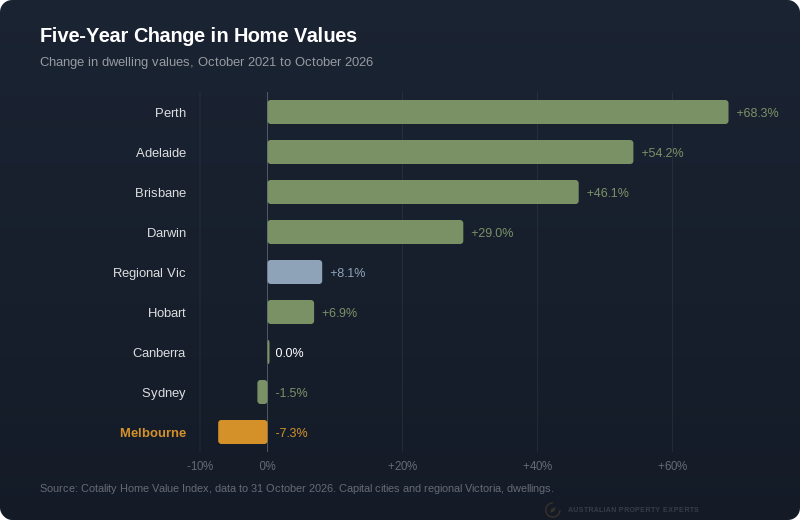
Prices are down 7.6% over the year to October. Rents have held up better. SQM Research has Melbourne’s asking rents 4.7% higher than a year ago, even after a 2% dip over the past quarter.
Victoria added 109,500 people in the year to March, according to the ABS. Over a similar stretch, the number of active rental bonds fell 0.3%. That leaves more tenants chasing slightly fewer rentals. Our Melbourne market update goes through supply in more detail.
Our Predictions for Victorian Property
1. Investors come back to Victoria in 2027
With Melbourne still below its 2022 peak and land tax cuts promised, I expect more investors to look at Victoria again in 2027.
2. More competition under each stamp duty cap
If the exemption goes up $100,000 every July, I expect the most competition just under each new cap. The first cap is $700,000 in 2027-28.
3. Regional Victoria keeps beating Melbourne
Regional Victoria rose 2.1% in the year to October while Melbourne fell. I believe that continues through 2027. Bendigo ($652,102, up 4.6%) and Ballarat ($628,253, up 4.3%) both have medians just above today’s $600,000 exemption. The first step to $700,000 covers the typical home in each.
4. Buyers have room to negotiate now
Sentiment in Victoria is low, so vendors are motivated and buyers have room to negotiate. That room may shrink as investors come back. There’s no tax reason to rush, though. Land tax is charged to whoever owns the land on 31 December, so any cut reaches you whenever you buy.
What Could Change the Timing
New governments often shift their timetable in the first budget. I’d plan any purchase on today’s rules and treat the cuts as a bonus if they arrive.
The federal negative gearing changes also start on 1 July 2027. They cover any established home bought after 7:30pm on 12 May 2026, so buying before July doesn’t get you around them. Check the numbers with your accountant before you buy.
Where We’re Buying in Victoria
Our 2027 location picks include Geelong, Wodonga, Ballarat and Bendigo. We’ve kept buying there through the downturn.
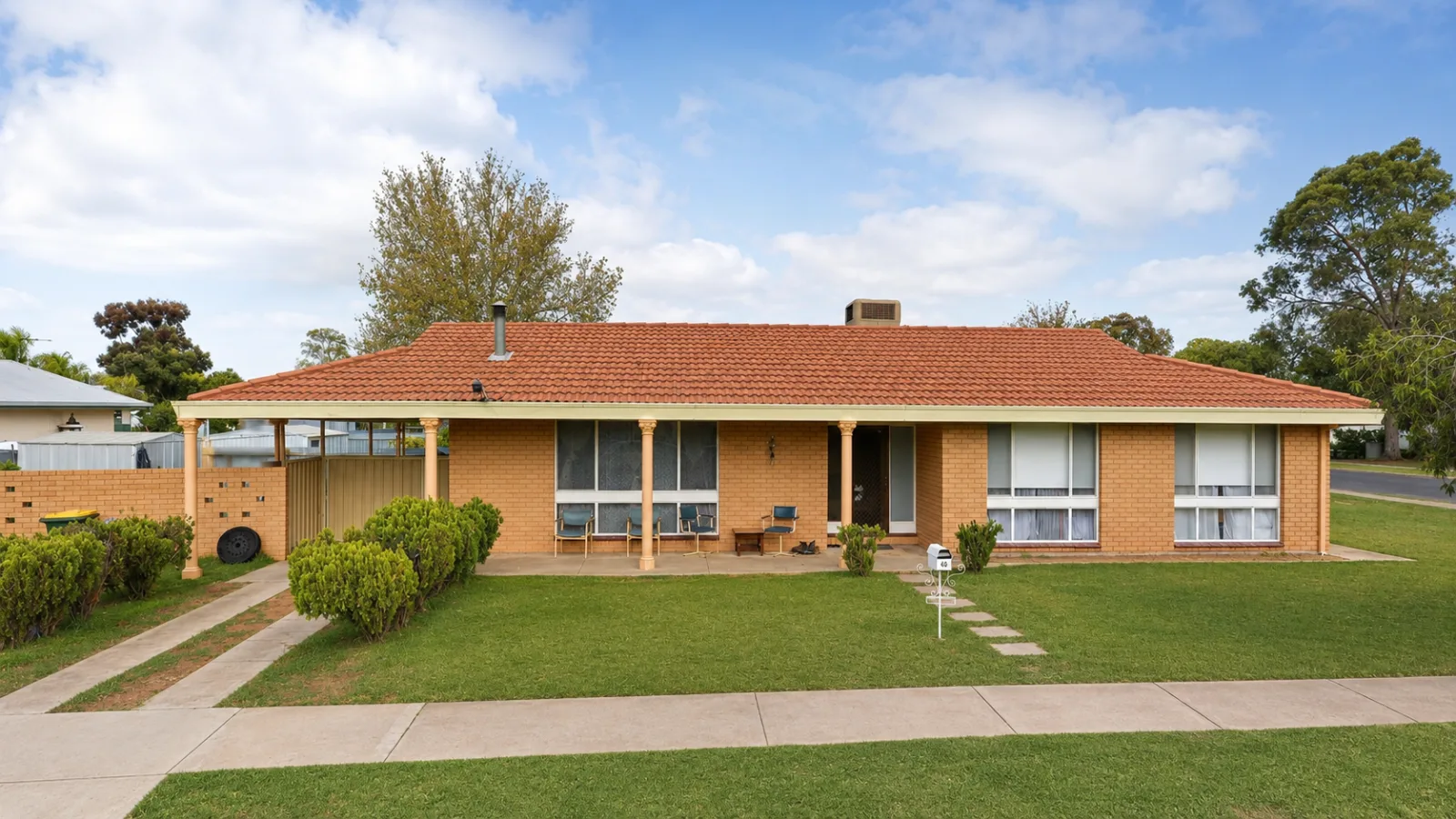
For one client, we bought a house in Victoria for $345,000 in March 2025. It was valued at $520,000+ in March 2026.
Our regional Victoria guide also covers Shepparton, Mildura and Warrnambool.
Victoria After the Election
I believe the biggest change from this election will be investors coming back to Victoria. If you’ve written Victoria off, it’s time to look again.
This is general information only and not financial advice. Speak to a qualified professional before making investment decisions.
If you’re thinking about buying in Victoria in 2027, book a free discovery call.